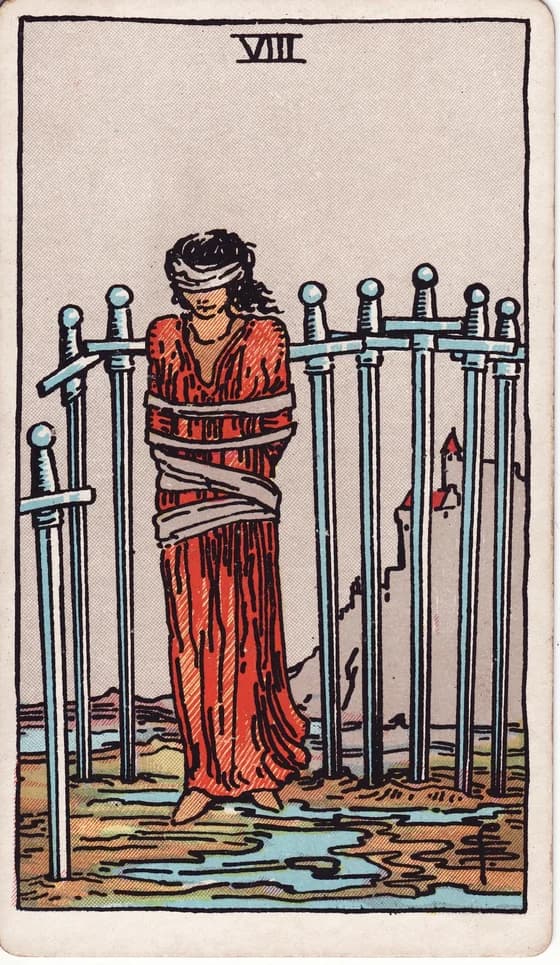
Covered eyes and bound arms with some ground still open
A red-robed figure stands on wet ground, blindfolded, with pale bands wrapped around the torso and arms. Eight swords stand at the sides and behind: three on the image’s left and five on its right. Water pools and exposed ground lie before the feet, and a building stands on distant high ground.
From our viewpoint, gaps between the swords and space ahead are visible. The figure does not share that view and is genuinely bound. Seeing a little space does not mean the person can simply leave if they want to. The composition can remind us that an outside perspective differs from the conditions actually available to someone who is trapped. View the image examined for this article
Waite leaves room for the restriction to be temporary
The text labelled 1911 explicitly distinguishes temporary confinement from irretrievable bondage. Waite’s list includes crisis, criticism and restrained power; reversal also includes difficulty and opposition, so it cannot simply mean freedom has arrived.
This article’s modern reflective reading is to identify limits and seek support. We do not use the old list to predict illness, accidents or harm, nor reduce a lack of resources or real oppression to a problem in the affected person’s thinking. Check Waite’s original entry
Upright: Make the difficulty specific enough to address
Upright, the card can point to narrowed choices: blocked information, insufficient resources or fear of a particular consequence. Ask which exact step cannot be taken and what prevents it. That helps more than demanding immediate positivity.
Some barriers come from external rules and need negotiation or assistance. Others are unverified assumptions that can be checked with someone. Distinguishing them does not make either kind easy. It simply turns “nothing can be done” into questions that can be addressed one at a time.
Reversed: Change still needs practical conditions
Reversed, the card can help you notice new options: access to information, someone willing to help, or your own increasingly specific requests. Alternatively, the restrictions may remain while self-blame grows. Confirm what support is available rather than forcing yourself past a real risk because a card is reversed.
Lack of authority and fear are different obstacles
If work is stuck at approval, find out who can authorise it, which document is missing and when a response is possible. Clear responsibilities may help more than silently working overtime to prove yourself.
If you want another job but have fixed expenses, begin by updating your résumé, exploring roles and preparing a buffer. Resignation need not be the only possible action. If studying leaves you thinking “I’m just incapable of learning this,” ask someone to observe one specific step. Missing prerequisite knowledge may be the issue, rather than a flaw in your whole ability.
Practice: Divide the obstacles into three columns
Write “Confirmed limits,” “Unverified worries” and “People or resources that may help.” Choose one concern in the second column to check, or make one specific request using the third. The aim is to see more of the available conditions, not prove that you should have escaped already.
Seeing an exit does not mean someone can use it
The Eight of Swords is not evidence that a trapped person caused their own difficulties, and it does not demand blind risk-taking. Where there is control, intimidation or an unsafe situation, trustworthy support and practical safety come before forcing action on the basis of a card.
Read next
Two of Swords: Compare delaying a decision with actual restrictions on action; Six of Swords: Look for a route and companions that can support a transition.
Sources for this article
- Pamela Colman Smith: Eight of Swords, actual RWS image at the fixed repository commit
- A. E. Waite, The Pictorial Key to the Tarot, Part III, Section 2, Eight of Swords
- Commons Swords08.jpg file page and upload history
Version note: The actual RWS WebP assets from a fixed repository commit were inspected individually. The Commons Pam-A file pages were used to check provenance and versions; no claim of pixel-for-pixel identity between the files is made. Waite is cited from an English transcription labelled 1911. The modern situations, questions and exercises were written originally for DestinyPixel, without borrowing paid card-meaning content.