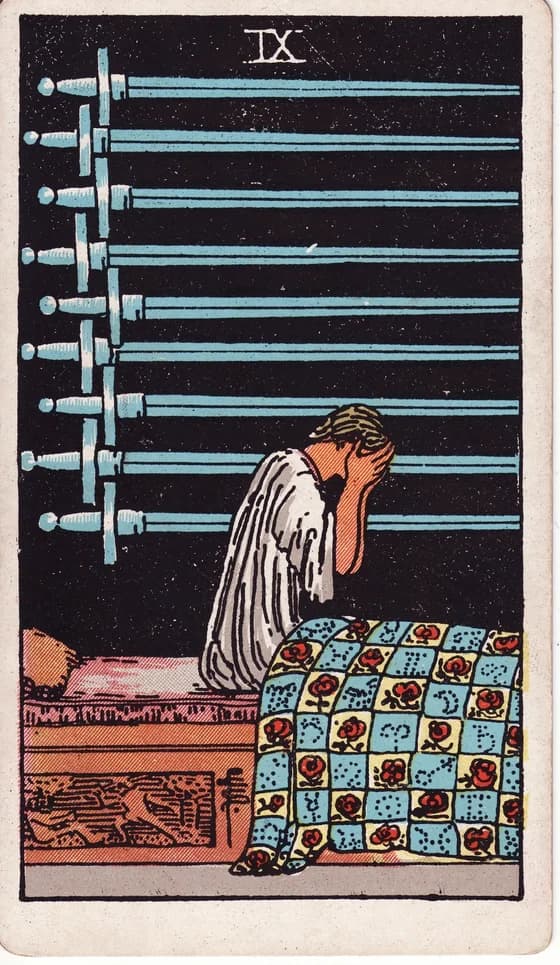
The swords cross the darkness without piercing the body
A person in a pale long garment sits on the edge of a bed, leaning forward with both hands covering their face. Nine swords lie horizontally across a black background, handles on the left and blades extending right. A quilt covers the legs, its squares alternating between red flowers and dark symbols. The bed’s side bears a carving of two figures, one holding something while approaching the other.
Black fills most of the image, making the seated person seem surrounded by their distress. Yet the swords are not shown piercing the body. Associating the horizontal rows with recurring thoughts is a modern way of reading the image. A still picture cannot establish whether the person has insomnia or any particular illness. View the image examined for this article
A heavy original text needs clear boundaries
In the transcription labelled 1911, Waite describes lamentation and profound sorrow. His reversed list includes suspicion, fear and shame. The older divinatory list contains specific calamities and health-related outcomes; this article does not treat them as real-world predictions.
The discussion of worry, repeated thinking and support below is a modern reflective extension. The Nine of Swords is not a mental-health diagnosis and cannot measure whether someone’s suffering is “serious enough.” Check Waite’s original entry
Upright: Put the story in your head into words
Upright, the card invites attention to an experience in which events remain uncertain but you have already lived through the worst outcome repeatedly in your mind. The feelings deserve care, while the difference between facts and projections still needs checking.
Worry is not always pointless; sometimes a real problem needs attention. Reduce it to one thing you can verify tomorrow, without requiring yourself to solve your whole life now. If sorting it out alone is difficult, telling someone trustworthy what support you need is also a useful action.
Reversed: Silence does not tell you whether things are improving
Reversed, the card may suggest beginning to voice a worry, or simply hiding it more deeply. Look for observable changes: access to support, less endless checking or a new way to address something. A reversed orientation cannot announce that every worry is about to disappear.
Check one thing before reaching a verdict
After submitting a report, you keep replaying a small mistake. First decide whether it affects the result. If it does, arrange one clear correction rather than spending the night imagining that everyone is criticising you.
If a friend has not replied for a short while, check whether anything is actually urgent instead of filling the silence with rejection. Before an exam, list the two topics that most need review and plan around the time available. If distress persistently affects sleep or daily life, seek appropriate professional support; a card reading cannot replace assessment.
Practice: Give worry an evidence column
Write down the worry that returns most often. Beside it, list “Facts that support it,” “What I do not know yet” and “When I can next check.” Add one small arrangement that can reduce tonight’s load. The aim is not forced optimism, but preventing a guess from posing as a settled outcome.
Distress does not prove disaster is coming
Do not read the Nine of Swords as a prediction of illness, death or inevitable failure, or dismiss someone’s circumstances as “just overthinking.” The card may help someone begin to speak; real difficulties still deserve real help.
Read next
Eight of Swords: Distinguish concrete restrictions on action from recurring worry; Four of Swords: Make room to reduce stimulation and recover.
Sources for this article
- Pamela Colman Smith: Nine of Swords, actual RWS image at the fixed repository commit
- A. E. Waite, The Pictorial Key to the Tarot, Part III, Section 2, Nine of Swords
- Commons Swords09.jpg file page and upload history
Version note: The actual RWS WebP assets from a fixed repository commit were inspected individually. The Commons Pam-A file pages were used to check provenance and versions; no claim of pixel-for-pixel identity between the files is made. Waite is cited from an English transcription labelled 1911. The modern situations, questions and exercises were written originally for DestinyPixel, without borrowing paid card-meaning content.