There is still a bright band beneath the black sky
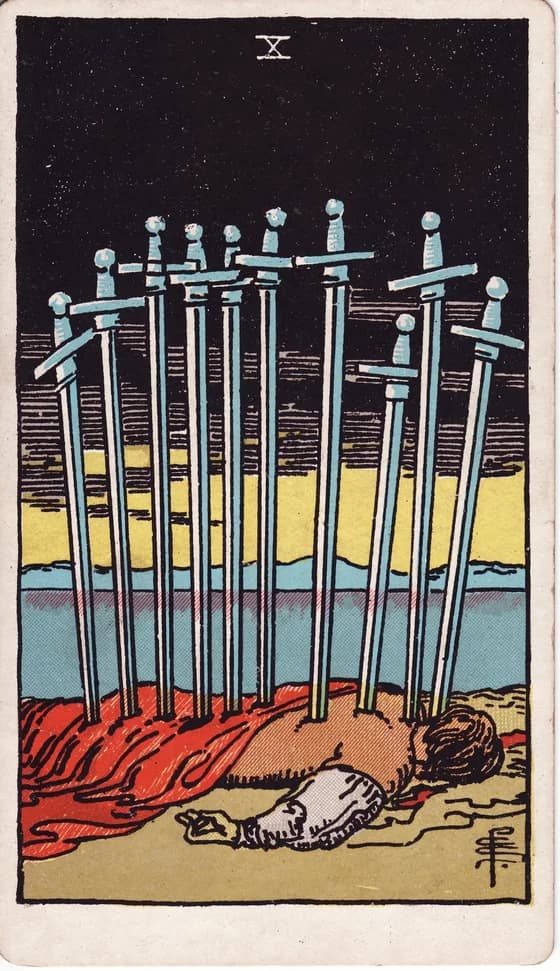
A figure lies face-down with their head to the right. Red fabric covers the lower body and one hand extends beside it. Ten swords pierce the back in a dense, uneven row. A broad black sky fills the upper image, while a yellow band appears near the distant water, with low mountains beyond.
The exaggerated number of swords pushes the sense of “no more can be borne” to an extreme. The distant brightness can suggest a new phase, but it supplies no timetable. The colours alone do not establish that this is sunrise. Acknowledge the ending in the foreground without treating the whole picture as sealed in darkness. View the image examined for this article
Waite explicitly limits a literal death reading
In the text labelled 1911, Waite writes of pain, sadness and desolation, and specifically says this is not especially a card of violent death. Reversal includes advantages, success and favourable conditions, with a warning that they may not last.
Reading the card as the end of an old approach, depletion and closure is a modern reflective application. Its forceful imagery offers no basis for predicting death, illness or violence. Nor does it guarantee that “we have hit bottom, so tomorrow must bring a rebound.” Check Waite’s original entry
Upright: Specify what cannot continue
Upright, the card can help you face an ending already becoming apparent: a plan lacks the conditions to continue, a promise cannot be fulfilled, or a long-used method has exhausted its resources. Admitting an ending does not make every past effort worthless.
Define the scope of what ends. It may be a version, a way of collaborating or a repeated self-blaming explanation, rather than your entire career or future. Then handle necessary handovers and preserve what you learned so the losses do not keep growing.
Reversed: Relief needs fresh support
Reversed, the card can help you notice reduced pressure, someone taking over or a willingness to close an old task. It may also reflect knowing something should end but reinvesting because you cannot accept the loss. Ask what the new conditions have genuinely changed. Retrying without changed conditions may simply repeat the same depletion.
Closing something can be more responsible than persisting
If project testing shows that the core assumption does not hold, preserve the records and explain why before stopping ineffective investment. Keep materials other work can reuse; the project itself need not survive.
When a collaboration ends, list outstanding deliverables and existing agreements rather than rushing to prove who failed completely. If a personal goal has required overextending yourself for months, stop the current intensity and choose a sustainable approach. Changing the plan does not mean giving up on yourself.
Practice: Put a boundary around an ending
Make two columns: “What ends here” and “What remains.” Make the first specific to a way of doing something. The second might include a skill, relationship or lesson. Choose one practical closing action so the ending becomes more than a verdict in your head.
This is not a final sentence on a person
The Ten of Swords does not mean your life is over or that hope must instantly reappear. Do not use it to predict anyone’s death or harm. Bring the image back to workable reality: what needs to stop, who can help and what needs care first.
Read next
Death: Compare broad transformation with a specific approach reaching its end; Six of Swords: Continue considering supported departure and transition.
Sources for this article
- Pamela Colman Smith: Ten of Swords, actual RWS image at the fixed repository commit
- A. E. Waite, The Pictorial Key to the Tarot, Part III, Section 2, Ten of Swords
- Commons Swords10.jpg file page and upload history
Version note: The actual RWS WebP assets from a fixed repository commit were inspected individually. The Commons Pam-A file pages were used to check provenance and versions; no claim of pixel-for-pixel identity between the files is made. Waite is cited from an English transcription labelled 1911. The modern situations, questions and exercises were written originally for DestinyPixel, without borrowing paid card-meaning content.