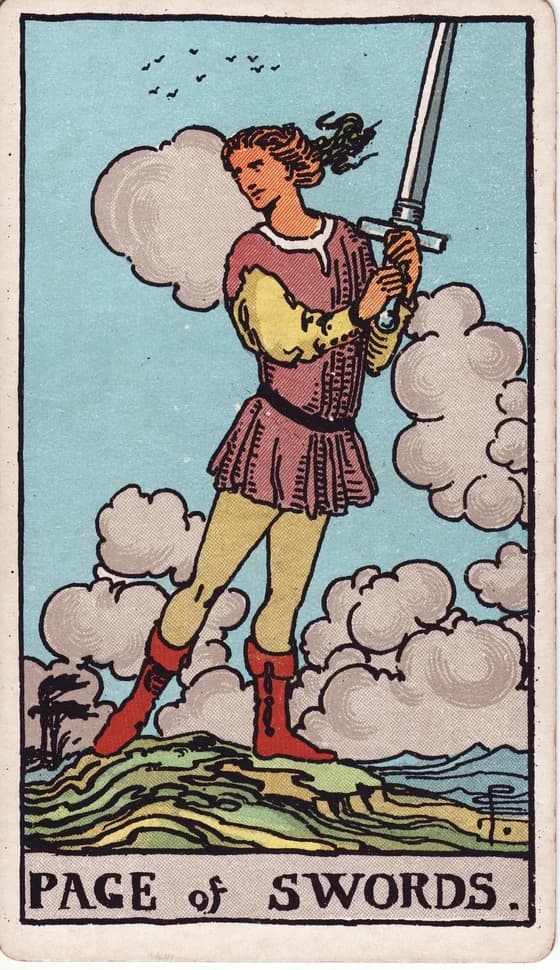
Feet on the ground with the head turned away
The figure stands on uneven green ground, wearing a purple-red tunic, pale yellow trousers and red boots. Both hands grip a sword extending toward the upper right, while the head turns left. Hair lifts, distant trees lean and large clouds gather around the body. Small birds are visible in the upper left.
The posture suggests attention to the surroundings, but no actual opponent is shown. Uneven ground adds instability to the readiness. The image can help us think about a beginner’s alertness and tension, but the figure’s appearance cannot establish the reader’s age, gender or maturity. View the image examined for this article
Waite emphasises observation and examination
In the transcription labelled 1911, Waite stresses vigilance, supervision and examination, describing someone continually looking around. Reversal concerns the unfavourable side of those traits and a lack of preparation. This article does not adopt the old list’s health-related predictions.
Understanding the Page as learning through questions and trying to express ideas is a modern reflective extension. It describes an approach anyone can practise, not a fixed young male identity, and cannot establish that someone is watching you. Check Waite’s original entry
Upright: Become a good questioner first
Upright, the card can encourage you to notice details, seek information and make vague questions specific. Beginners do not need complete answers. Checking a concept is more useful than pretending you already understand.
Sharp observation also needs a way to keep records. Distinguish what you saw yourself, what someone told you and what you inferred, retaining the source and time. The finer your observation, the more carefully you should judge how much the evidence supports. One inconsistency need not become an entire story.
Reversed: Notice how information is being processed
Reversed, the card may prompt you to check for missing context, speaking too soon or turning questions into interrogation. You may also be unprepared for a new task and hiding uncertainty behind vigilance. Slow down before passing information on, restore its context and let other people give a complete explanation.
Ask questions that someone can actually answer
When joining a team, take a real task and ask a colleague who confirms each step rather than asking only “What is the process?” Record the answer. Next time, consult it first and ask about what is genuinely new.
With surprising news, find the original publisher and date; a screenshot is not the whole context. If someone’s tone changes in a relationship, ask, “Is there something on your mind today?” rather than using tests and repeated questions to make them prove their innocence.
Practice: Label a message in three ways
Choose something you plan to pass on and mark each part “Verified,” “Reported by someone else” or “My guess.” Find the source for its most important claim and reread the context. If it is unverified, say so when sharing it instead of making your tone sound more certain.
Curiosity does not grant access to everything
The Page of Swords cannot prove that someone is snooping, lying or secretly paying attention to you. Verification must respect privacy and permission. Wanting to know something does not automatically entitle you to inspect another person’s device or private messages.
Read next
Ace of Swords: Organise checked information into a clear judgment; Seven of Swords: Distinguish reasonable verification from intrusive investigation.
Sources for this article
- Pamela Colman Smith: Page of Swords, actual RWS image at the fixed repository commit
- A. E. Waite, The Pictorial Key to the Tarot, Part III, Section 2, Page of Swords
- Commons Swords11.jpg file page and upload history
Version note: The actual RWS WebP assets from a fixed repository commit were inspected individually. The Commons Pam-A file pages were used to check provenance and versions; no claim of pixel-for-pixel identity between the files is made. Waite is cited from an English transcription labelled 1911. The modern situations, questions and exercises were written originally for DestinyPixel, without borrowing paid card-meaning content.