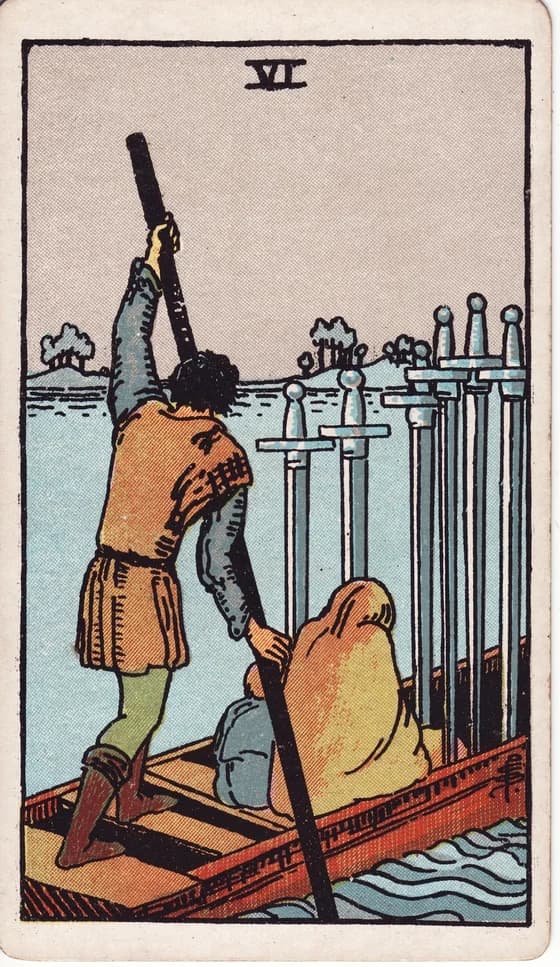
The boat moves forward with the swords aboard
A narrow boat stretches from the foreground toward the right. A person stands at the stern using a pole. Ahead sits someone wrapped in yellow-brown fabric, with a smaller figure beside them. Both face away from us. Six swords stand in the forward part of the boat, their handles at different heights and their blades obscuring part of the view ahead.
The water nearest the boat has distinct ripples; farther away it is smoother, with scattered trees along the shore. The swords have not been left behind, and no one is celebrating. This can suggest moving on with unresolved matters, but the image does not explain the passengers’ relationship, their reason for leaving or whether the destination will satisfy them. View the image examined for this article
The original includes routes and commissions
In the text labelled 1911, Waite calls the standing person a ferryman and describes a smooth passage with a load within their capacity. His meanings include water travel, routes, an envoy, a commission and an expedient. Reversed, he writes of declarations, confession and publicity, rather than a single meaning of being unable to leave.
Transition, assistance and unfinished matters are this article’s modern reflective extensions. Movement is not restricted to long-distance travel, and a boat in the image does not predict a move, emigration or a particular itinerary. Check Waite’s original entry
Upright: Make the next step workable
Upright, the card can suggest moving from a high-friction situation toward a more manageable arrangement. You may not feel at ease or know the destination fully, but you can establish a route, handover tasks and support.
It is especially useful to ask who is doing the work of moving things forward. Someone poles the boat while others may only be able to sit for now. Cooperation does not require everyone to contribute in the same way at the same moment. Accepting practical help is also a capacity that makes change possible.
Reversed: Ask which connection is still missing
Reversed, the card can draw attention to uneven transitions: arrangements have changed but habits have not, or someone has left without a necessary explanation. Perhaps the route itself needs reconsidering. Find the specific obstacle rather than calling all hesitation a fear of growth. A lack of practical resources can also make movement difficult.
A handover matters more than an elegant fresh start
When changing teams, list open work, where materials are stored and who will take over. Old responsibilities then have somewhere to go, and the new arrangement can progress even while your feelings are mixed.
Two people who want to stop a pattern of repeated arguments can begin by discussing one issue at an agreed time, perhaps with help from someone they both trust. If you miss your old life after relocating, that does not prove the move was wrong. Establish small routines for shopping, commuting and contacting friends so the new place gradually becomes livable.
Practice: Map a short route
Divide a page into “Now,” “Next stop” and “Who or what can help.” Make the next stop a near-term action, such as arranging a handover or finding a contact. Add one worry that will still travel with you, as a reminder that you need not pretend everything is resolved.
Leaving does not make everything better automatically
The Six of Swords does not promise a happier far shore or require you to leave everyone behind alone. Examine the route, the load and the help available. Whether life improves must be answered by what actually happens after the move.
Read next
Four of Swords: Distinguish pausing to recover from beginning a transition; Eight of Cups: Compare supported movement with actively seeking a new direction.
Sources for this article
- Pamela Colman Smith: Six of Swords, actual RWS image at the fixed repository commit
- A. E. Waite, The Pictorial Key to the Tarot, Part III, Section 2, Six of Swords
- Commons Swords06.jpg file page and upload history
Version note: The actual RWS WebP assets from a fixed repository commit were inspected individually. The Commons Pam-A file pages were used to check provenance and versions; no claim of pixel-for-pixel identity between the files is made. Waite is cited from an English transcription labelled 1911. The modern situations, questions and exercises were written originally for DestinyPixel, without borrowing paid card-meaning content.