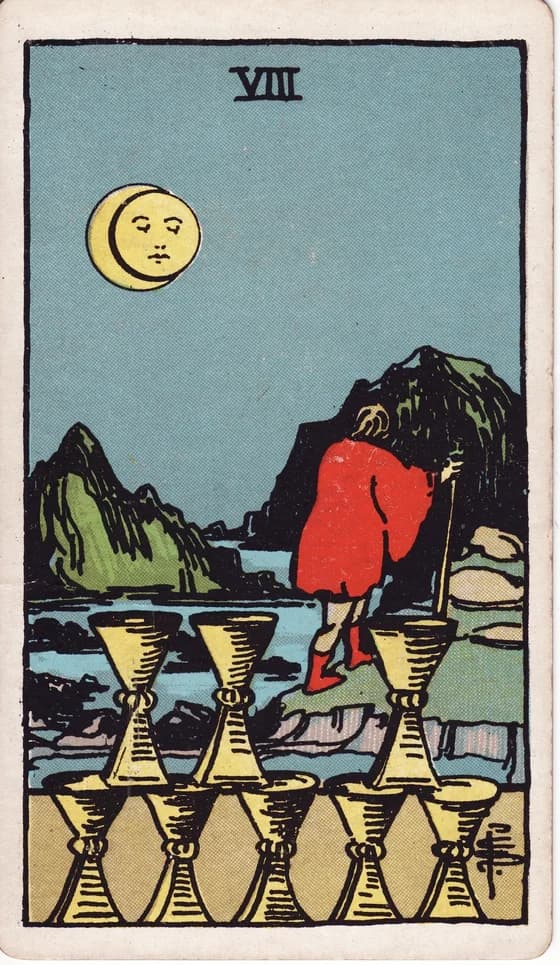
The cups remain intact while the figure turns away
Eight golden cups form two rows in the foreground: five below and three above, with gaps in their arrangement. None has fallen. A red-clad figure faces away from the viewer, holding a long staff and stepping towards rocky ground on the right, leaving water and layered rock behind.
In the sky, a yellow disc overlaps a crescent outline, with facial features on the circular form. Broad blue-grey space makes the traveller appear small. There is no ninth cup and no visible destination. Naming a gap as a destined absence, or assigning the moon a precise astronomical event, would go beyond what this article can verify in the image. View the card image
Waite preserves contradictory older interpretations
The 1911 English transcription of Waite’s The Pictorial Key to the Tarot describes a figure leaving cups associated with former happiness, enterprise or concern, while noting that some older readings are entirely opposite. His more usual direction is decline in a matter, or discovering that it matters less than was thought. Reversed, he lists great joy, happiness and feasting. Waite’s entry for this card
The hesitation, return and reassessment discussed below are this site’s modern extensions, not Waite’s historical reversed meaning. Learning to read includes noticing these differences rather than pretending there has always been one answer.
Upright: Separate past effort from worthwhile future effort
Time already spent cannot be recovered, but how much to invest next is still a choice. Ask: if I had known these conditions at the start, would I have begun? This can help distinguish momentum from genuine willingness.
Leaving also involves real responsibilities. Check handovers, costs, agreements and available support before choosing to exit, reduce your involvement or take a break. The image can help organise your reasons; it cannot issue a resignation, breakup or breach-of-contract instruction for you.
Reversed: Going back and forth is not necessarily weakness
Wanting to go and then staying may mean your reasons are unclear, or that practical conditions do not yet allow departure. Separate them: wishes need honesty, conditions need preparation. Do not judge an unchangeable constraint as a lack of courage.
Also ask whether a single setback has prompted the wish to leave. If a rest, changed responsibilities or a renewed discussion of goals could improve things, staying can be an active decision too. What matters is knowing why you choose, not proving how effortlessly you can walk away.
Change direction without unnecessary loose ends
If a year-long course no longer serves your goals, list the skills gained and requirements remaining, then compare finishing, pausing and changing courses. Past effort still has value; endless renewal fees are not needed to prove it.
If volunteering leaves you chronically depleted, give notice that you will reduce your hours and arrange a handover. If needs differ in a relationship, express your real thoughts when it is safe to do so. Where threats or harm are present, practical safety and support take priority over a card meaning.
Practice: Write a short account of the change
Write four sentences: what I originally wanted; what I am actually receiving; one adjustment still worth trying; how I will reduce my involvement if it does not improve. Allow a reasonable observation period for the adjustment, so preparation does not become endless postponement.
A common misreading
The Eight of Cups does not require immediate departure or guarantee greater happiness afterwards. The intact cups remind us that an ending need not arise from total failure. The future still needs exploring; this card cannot verify the next destination in advance.
Read alongside
Four of Cups: Distinguish a temporary wish to disengage from a serious change of direction; Five of Cups: Understand the regret that can remain while leaving.
Sources for this article
- Pamela Colman Smith: Eight of Cups, Commons Pam-A scan
- A. E. Waite, The Pictorial Key to the Tarot, Part III §2, Eight of Cups
Edition note: the text was checked against the English transcription at Sacred Texts labelled [1911]. The image is the scan currently labelled Pam-A on Commons. The modern situations, questions and exercises were written originally by DestinyPixel. Historical divinatory terms are learning material, not predictions or evidence about real events.