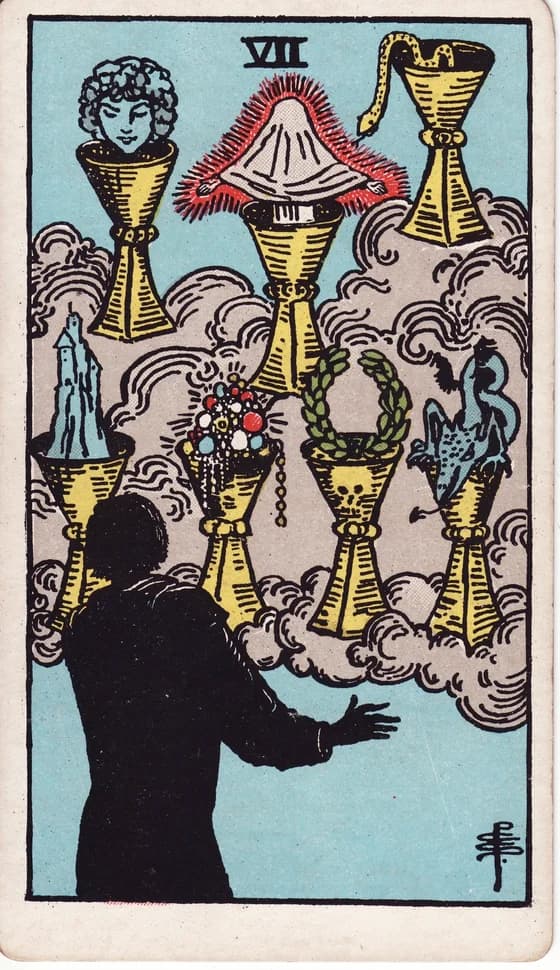
The seven cups hold different things
A dark figure stands in the foreground with a hand extended towards seven golden cups arranged on clouds. At the top are a face, a white-draped form surrounded by red rays, and a snake reaching over a rim. The lower cups contain a tower-like building, colourful jewels, a green wreath and a winged dragon-like creature.
The cups hang among clouds without a table or firm ground, and the figure has not actually taken hold of any of them. Beauty, wealth, honour and unsettling forms appear together, creating temptation and uncertainty. A striking object does not establish that it must correspond to a particular real person. View the card image
The text separates imagination from substantial results
The 1911 English transcription of Waite’s The Pictorial Key to the Tarot connects the visions in the cups with imagination, reflection and contemplation. It specifically notes the absence of permanent or substantial results. Reversed terms include desire, will, determination and a project. Waite’s entry for this card
Selection and testing therefore have historical points of connection, but the practical decision method below is this site’s own work. We do not assign the seven images a single definitive list of life goals or turn them into seven fixed predictions.
Upright: Explore, then stop adding options indefinitely
Imagination has a useful stage. List projects, ways of living or relationships you would like to try without immediately criticising yourself. Yet more options do not automatically mean more opportunities. Possibility begins to take shape when information and conditions are confirmed.
If you keep comparing but never try anything, write down the actual basis of your decision. Do you want a skill, more freedom or other people’s approval? Different needs can give the same option a completely different priority.
Reversed: Give determination a checkable task
The reversal can suggest withdrawing attention from a dazzling array of visions and choosing a direction. Turn the goal into something you can complete this week: speak to someone in the field, make one sample page or confirm enrolment requirements.
Narrowing your choice has risks too. In a rush to end uncertainty, you may ignore unfavourable information. Keep a backup option and decide in advance what evidence would make you reconsider. Stay committed to the underlying need, not necessarily to the first attractive picture of it.
Three moments when imagination can run ahead
When choosing a course, do more than save promotional pages. Check the schedule, actual workload and suitability for your present level, then select one you can try.
If you have many project ideas, use the same criteria to choose one small prototype to test. With a new acquaintance, a single shared interest can easily be expanded into an imagined personality. Ask about real experiences and observe continuing interactions instead of filling the gaps with your wishes.
Practice: Pair each wish with evidence
List no more than three options. For each, note its main attraction, the facts you currently know and one condition still to confirm. Investigate the most important unknown. Today, add evidence rather than options, then choose whether to test, set aside or rule something out.
A common misreading
The Seven of Cups does not say that wishing brings results, and it cannot diagnose delusions or any mental disorder. A rich imagination is not a fault. The question is whether imagination is being treated as something that has already happened. The card is useful for practising discernment, not mocking dreamers.
Read alongside
Knight of Cups: See how an imagined possibility becomes a proposal and action; Nine of Cups: Distinguish hoped-for satisfaction from satisfaction already experienced.
Sources for this article
- Pamela Colman Smith: Seven of Cups, Commons Pam-A scan
- A. E. Waite, The Pictorial Key to the Tarot, Part III §2, Seven of Cups
Edition note: the text was checked against the English transcription at Sacred Texts labelled [1911]. The image is the scan currently labelled Pam-A on Commons. The modern situations, questions and exercises were written originally by DestinyPixel. Historical divinatory terms are learning material, not predictions or evidence about real events.