The flowers are offered, not merely displayed
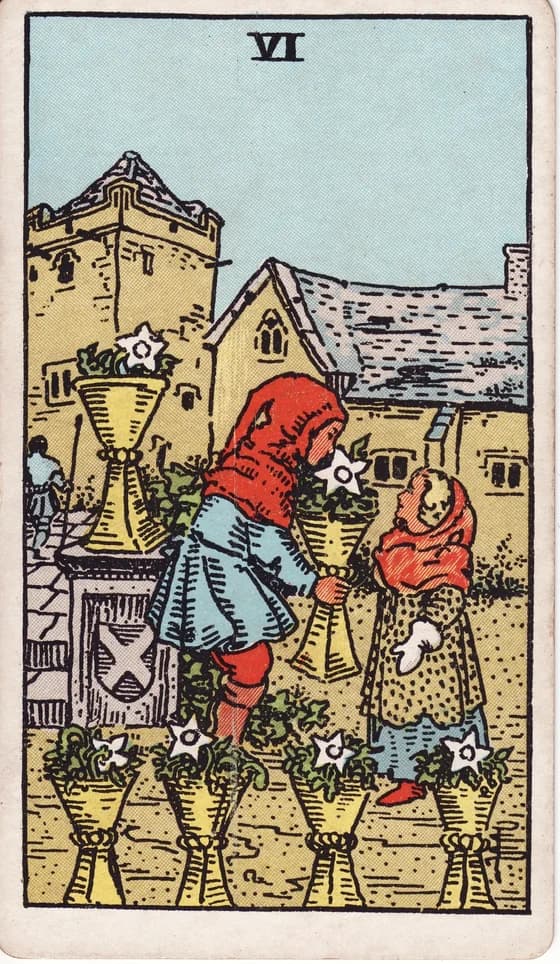
Two childlike figures face each other in a courtyard enclosed by yellow buildings. The taller figure, in a red hood and blue clothing, holds a cup containing a white flower and leans towards the smaller figure. The smaller figure wears an orange-red head covering and a dark-spotted garment, looking up at the other.
Four more flower-filled cups stand in the foreground, with a sixth on a stone pedestal at the rear left. White star-shaped flowers and green leaves recur across them. Further back on the left, a figure walks away with their back to the viewer. There is exchange, shelter and movement in different directions: the figures’ actions and orientations are not all the same. View the card image
Waite records both the past and unfamiliar surroundings
The 1911 English transcription of Waite’s The Pictorial Key to the Tarot begins with children in an old garden and names the past, childhood memories and vanished happiness. It also records an opposite reading: the children might be in unfamiliar surroundings, encountering new relationships and knowledge. Waite’s entry for this card
The reversed entry favours the future and renewal. This site therefore connects upright memory with reversed movement forward while retaining the openness of both readings. Nostalgia is not presented as the only interpretation all readers agree on.
Upright: Identify the actions behind the warmth
When you miss a person or a period of life, ask what mattered in practical terms. Perhaps someone listened without interrupting, meals had a shared rhythm, or help was given without an ulterior motive. Naming these actions makes a memory usable in the present.
Kindness can be simple: remember a friend’s preferences, share a suitable book, or practise a skill you enjoyed as a child. It need not require the other person to return to an earlier version of the relationship, nor become a debt of favours.
Reversed: You need not keep playing your old role
The reversal can invite a fresh look at the present. An old friend’s life has changed; the role you once played well may no longer fit. Past closeness is worth valuing, but current boundaries, time and values still need to be discussed.
If you remember only the best of the past, write down some of its difficulties too. If the past was not warm, there is no need to beautify it to fit a card meaning. Renewal can preserve useful experience while refusing to repeat painful ways of relating.
Turn nostalgia into something small and real
When meeting a former classmate after years apart, ask about their current life rather than only repeating old nicknames. You can share memories and accept that your interests no longer fully match.
While sorting old work, find one method that once made creating enjoyable and try it in a small exercise today. If a family member says you used to be different, calmly explain your present choices and arrangements. Closeness does not oblige you to preserve the same division of responsibilities forever.
Practice: Keep one useful action
Choose a memory you are willing to revisit and describe what someone actually did, rather than only saying those were good times. Try one action that still fits today, noting which conditions have changed. If looking back is uncomfortable, use a recent small kindness instead.
A common misreading
The Six of Cups cannot prove an ex will return or guarantee that an old relationship is safe. Familiarity can lower your guard; renewed contact still depends on present wishes and behaviour. The pictured children are artistic figures, not evidence of pregnancy, parenthood or a particular child’s future.
Read alongside
Five of Cups: Explore how regrets within a memory can be held; Ten of Cups: Develop familiarity into a present-day sense of belonging.
Sources for this article
- Pamela Colman Smith: Six of Cups, Commons Pam-A scan
- A. E. Waite, The Pictorial Key to the Tarot, Part III §2, Six of Cups
Edition note: the text was checked against the English transcription at Sacred Texts labelled [1911]. The image is the scan currently labelled Pam-A on Commons. The modern situations, questions and exercises were written originally by DestinyPixel. Historical divinatory terms are learning material, not predictions or evidence about real events.