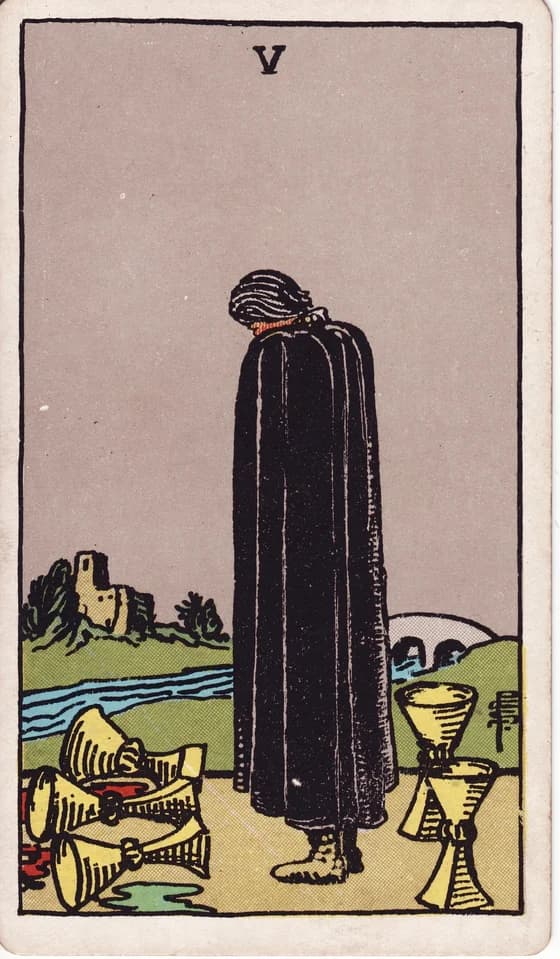
Three cups have fallen and two still stand
Under a grey sky, a figure wrapped in a long black cloak stands with head lowered, facing left. Three golden cups lie overturned at their feet, with red and green liquid on the ground. Two more cups stand upright behind the figure on the right; the figure has not turned towards them.
A blue river crosses the background, with an arched bridge on the right and a small towered building on green land across the water. The cloak encloses the figure, while the river, bridge and distant dwelling draw the eye further away. The bridge offers a visible route, but no promise that crossing it will compensate for every loss. View the card image
The historical text leaves something beyond the loss
The 1911 English transcription of Waite’s The Pictorial Key to the Tarot explicitly describes losing something while something else remains. Its older meanings also include inheritance or transmission falling short of expectations. The reversed entry names news, connections, kinship and return, but also false projects; its directions are not entirely consistent. Waite’s entry for this card
This site’s use of the reversal for accepting support again and processing regret is a modern reflective extension. We do not infer from a card that an inheritance, marriage or any specific event has occurred. The starting point should be what a person has actually experienced.
Upright: Be specific about the disappointment
What hurts may be more than an unsuccessful outcome: perhaps your effort went unseen, or the future you expected is no longer possible. Naming what you have lost makes it easier to identify useful help than simply telling yourself to look on the bright side.
Acknowledging loss does not require you to remain still. You can feel regret while attending to what must be done today, and you can postpone any search for a positive meaning. The two standing cups invite you to check available resources, not to feel grateful on demand.
Reversed: Reconnecting can happen in small steps
The reversal can help you notice a small opening: replying to a friend, picking up daily routines, or talking about what happened without only blaming yourself. Even slight changes deserve attention.
Another possibility is saying it is over while organising every action around repairing the old outcome. Separate what remains repairable from what cannot be changed. Then decide where a remedy is possible and where further effort is only adding to the cost.
Planning after an opportunity is lost
If your project application was rejected, first find out whether assessment feedback is available, then decide what to revise. Failure can affect your mood without erasing the experience and work you already have.
If a friend cancels a long-awaited trip, express your disappointment and check cancellation arrangements. You need not immediately cover the feeling with another trip. If you are saying goodbye to an important relationship, allow yourself to seek trusted company. Real companionship is more useful than asking a card repeatedly whether the person will return.
Practice: Separate three things
Write three headings: what has been lost, what is still here, and what I need today. Put only real, specific things under each. Choose one manageable action for the day, such as arranging an available refund, eating a meal or telling a friend you would like company.
A common misreading
The Five of Cups does not predict death or impose a timetable for grief. Urging someone to cheer up because two cups remain ignores what the three lost cups meant. It is more useful for holding two truths together: this is genuinely painful, and life may still have other sources of support.
Read alongside
Eight of Cups: Compare facing a loss with choosing to leave; Six of Cups: Notice how memories affect the present.
Sources for this article
- Pamela Colman Smith: Five of Cups, Commons Pam-A scan
- A. E. Waite, The Pictorial Key to the Tarot, Part III §2, Five of Cups
Edition note: the text was checked against the English transcription at Sacred Texts labelled [1911]. The image is the scan currently labelled Pam-A on Commons. The modern situations, questions and exercises were written originally by DestinyPixel. Historical divinatory terms are learning material, not predictions or evidence about real events.