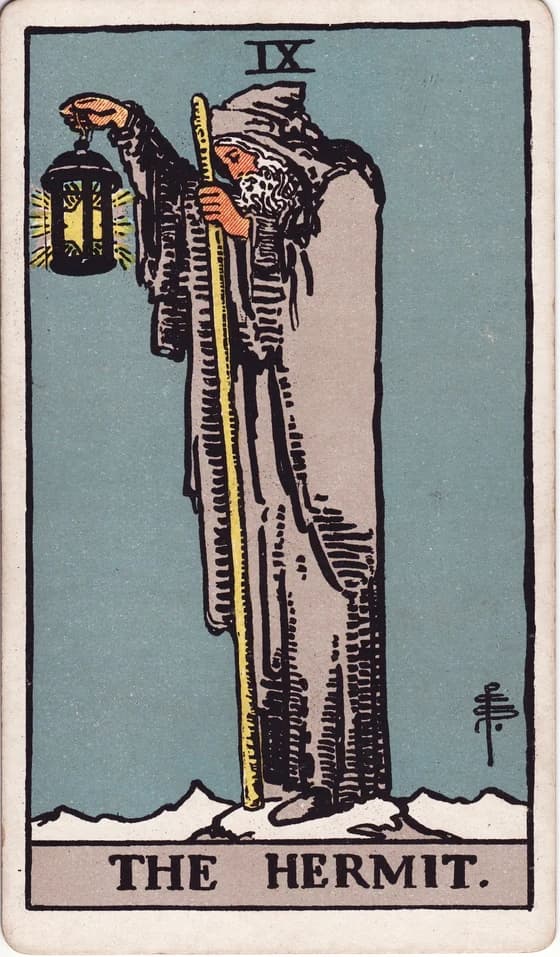
The lamp is held out, and the figure stands high
Against a grey-blue background, an elderly man in a long cloak stands alone on a white mountain ridge. His hood is low, his white beard reaches his chest, and his face turns toward the lower left of the picture. One outstretched hand raises a lantern; the other holds a long staff. The staff touches the ground, forming a slender vertical line alongside his body.
A star-shaped light shines inside the lantern, with rays extending beyond its frame. The cloak covers most of his body but leaves the lamp exposed. There are no companions, houses or clearly marked road into the distance, and no light filling the sky. Your eye catches that small patch of yellow, then travels down toward the rocks at his feet. The question of how far the light reaches becomes something you can actually observe. View the card
This light also faces other people
Waite emphasises that the lamp is not hidden beneath the cloak and that a star shines inside it. He reads the figure holding a beacon on high as someone who has attained a particular state and points the way for others. He rejects simple descriptions of a truth-seeking old man or occult self-isolation. The Hermit can therefore suggest both time alone and the guidance an experienced person offers. Waite, Part II, IX
Upright: Focus on what deserves a closer look
Our modern reading is to reduce distractions for a while, examine sources and experience carefully, and form your own judgement. You need not answer everything at once. Distinguishing what you know from what you do not can show you what to investigate and whom to ask next.
The Hermit can also suggest a mentor or a period of serious study. Good guidance helps you discern and verify; it does not require you to surrender all judgement. Experience can illuminate a stretch of road that you still have to walk yourself.
Reversed: When quiet becomes isolation
Check what solitude is doing for you. After some time alone, are things clearer, or are you circling the same thought? Do you simply need a break from explaining yourself, or has any feedback become hard to accept? The opposite situation is also possible: other people’s opinions fill your life, leaving no space for your own reflection.
Waite’s divinatory list includes concealment, fear and unreasoned caution, alongside other very negative historical associations. We do not use those labels to identify someone as deceitful. Observable behaviour and communication come first. Waite, Part III, §3, entry 9
Three moments when a little distance helps
Before changing jobs, close the job recommendations for an evening and write down the three things that drained you most in your previous role. Compare them with actual job requirements, rather than chasing a more impressive title.
When studying, take a precise sticking point to a teacher: “I understand this far. Why does the next step follow?” That is closer to using a lamp to light a short stretch than collecting another complete course.
If you need space in a relationship, explain: “I would like tonight to myself. Let’s talk tomorrow evening.” Naming a time to return helps distinguish reflection from disappearing without explanation. A Hermit card cannot tell you whether someone has stopped caring or is simply busy.
Practice: Follow just one question
Choose something that repeatedly distracts you and turn it into one question you can investigate. Spend twenty minutes looking only for evidence relevant to it. Finish by noting your current answer, one remaining uncertainty and someone you could consult. Do not make “understand my whole life” the goal of this exercise.
A common misreading
One person in a picture does not mean you are destined to be lonely. Solitude is useful when it helps you regain judgement, learn and reconnect with life. Distance from other people is not, by itself, a measure of its value.
Read next
The High Priestess: compare listening to what is still unclear with active inquiry; The Hanged Man: compare stepping back to observe with changing your angle of view.
Sources for this article
- Pamela Colman Smith: The Hermit, the scan identified on Commons as Pam-A
- A. E. Waite, The Pictorial Key to the Tarot, Part II, §2, IX The Hermit
- A. E. Waite, The Pictorial Key to the Tarot, Part III, §3, entry 9
Edition note: the visual descriptions were checked against the current Pam-A scans on Commons. References to Waite use the English transcription labelled [1911] on the source pages. The contemporary situations, questions and exercises are original DestinyPixel teaching material; no paid collections of card meanings were used.