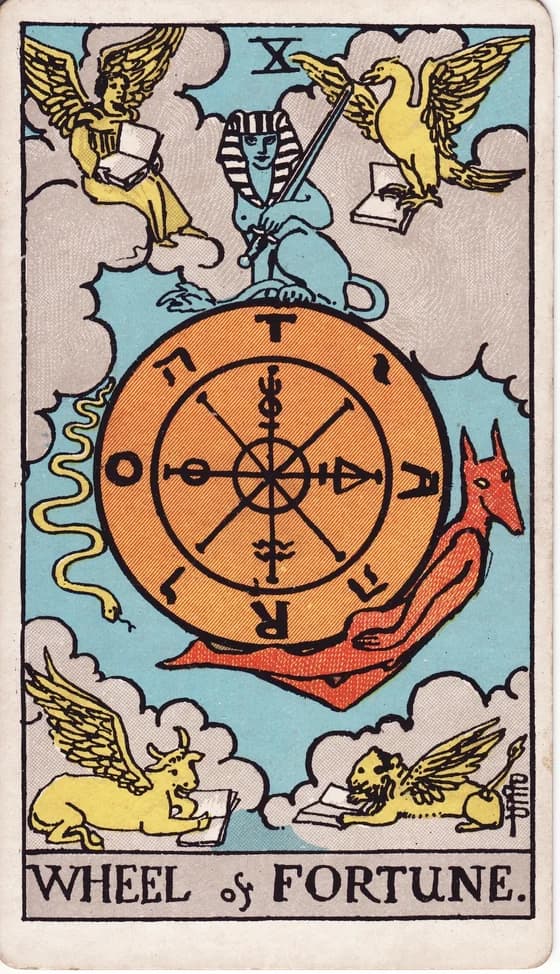
Follow the wheel, then look at the four corners
A large orange wheel fills the centre of a blue sky and clouds. Several concentric rings divide its surface, with spokes radiating from the middle. Latin and Hebrew letters appear on the outer ring, and further symbols inside. A blue sphinx sits on top, holding a sword in its forelimbs. A yellow serpent descends on the left. At the lower right, a red figure with a human body and a long-snouted animal head curves upward along the rim, supporting it.
Each corner contains a winged figure with a book: a human figure at upper left, an eagle at upper right, a bull at lower left and a lion at lower right. The curved rim and flanking bodies suggest motion, while the four corners hold the composition steady. No one turns a handle, and no ordinary person controls the whole scene. View the card
Mixed symbolism does not prove an Egyptian origin
Waite says he adopted and adapted Éliphas Lévi’s design. He connects the corner figures with the four living creatures of Ezekiel, the wheel with the flux of human life, and the sphinx with balance within it. He explicitly says that using Egyptian symbolism does not establish an Egyptian origin for tarot. The mixture belongs to this particular symbolic arrangement. Waite, Part II, X
Upright: Notice openings and leave some room
Our upright reading focuses on changing conditions. A previously closed route may open, while a familiar method may need updating. You can take an opportunity while checking how long it lasts, its conditions and its actual costs. Responding to the moment means using new information, not treating every coincidence as an instruction.
The wheel keeps turning, and progress still needs care. When a collaboration first attracts attention, organising capacity and routines is more practical than assuming the interest will last indefinitely.
Reversed: Separate setbacks, excess and repetition
Modern readings often use the reversed card to explore feeling stuck, repeating patterns or resisting change. We use that approach to practise adaptability, but it is not Waite’s wording. His reversed entry lists increase, abundance and superfluity. Another useful question is therefore whether opportunities are arriving faster than your resources can handle. Waite, Part III, §3, entry 10
Identify what has actually changed. Has an external condition delayed the schedule, or do you keep returning to the same approach despite feedback? The first may call for a buffer and an alternative plan; the second may require a different method. They are not the same kind of “bad luck.”
When events outrun the plan
If a flight changes, first confirm the new time, then reorganise transfers and accommodation. List what can be changed or refunded and when decisions are needed. Here the card helps organise your response; it cannot reveal the airline’s next decision.
A small shop suddenly receives many orders. Upright, the card can prompt you to use the opening in demand; reversed, to check whether you are overcommitted. Give realistic delivery dates, limit additional orders if necessary, then consider extra help.
If several applications for the same kind of role go nowhere, compare your materials and the feedback. Distinguish hiring conditions in the industry from problems in your résumé. Drawing a “lucky” card is no reason to skip preparation, place bets or seek investment returns.
Practice: Leave a way to adapt
Make three columns: conditions that have changed; actions I can adjust; things I cannot currently control. Choose one small action from the second column for today, and write an alternative plan. A few days later, review what actually happened instead of looking only for coincidences that fit the card.
A common misreading
The Wheel does not guarantee approaching good luck or decree that bad events must repeat. Its most useful question is: now that circumstances have changed, am I still following an outdated plan?
Read next
The Tower: compare cyclical movement with a sudden structural change; The World: compare changes within a cycle with the completion of a stage.
Sources for this article
- Pamela Colman Smith: Wheel of Fortune, the scan identified on Commons as Pam-A
- A. E. Waite, The Pictorial Key to the Tarot, Part II, §2, X Wheel of Fortune
- A. E. Waite, The Pictorial Key to the Tarot, Part III, §3, entry 10
Edition note: the visual descriptions were checked against the current Pam-A scans on Commons. References to Waite use the English transcription labelled [1911] on the source pages. The contemporary situations, questions and exercises are original DestinyPixel teaching material; no paid collections of card meanings were used.