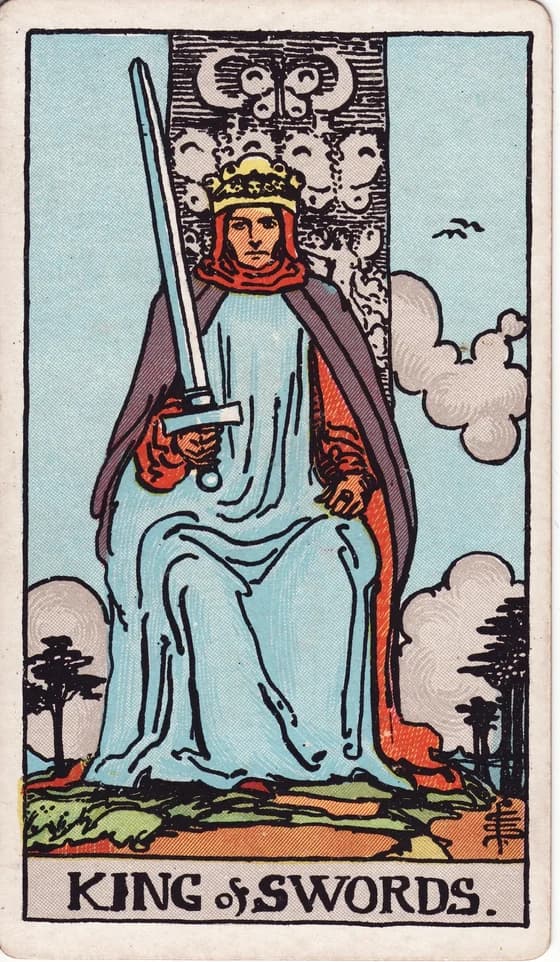
A frontal figure with the sword tilted slightly aside
The King sits facing us on a high-backed stone chair. A blue robe covers the legs, a purple cloak lies outside it and red appears at the neck and lining. The right hand holds a sword angled slightly toward the upper left, while the other rests beside the body. Above the crown, the chair’s back contains symmetrical carvings, including a clear butterfly shape.
Trees, clouds and blue sky flank the figure, with birds in the upper right. Compared with the Knight’s forward charge, this figure and chair form a stable central axis. Stability can support deliberation, but can also suggest a position reluctant to change. The image does not guarantee that a person in authority is correct. View the image examined for this article
Waite focuses on the power conferred by office
In the transcription labelled 1911, Waite places the King in a position of judgment, connecting the card with authority, command and law. He notes its resemblance to the Major Arcana card Justice, while placing greater emphasis on the power granted by office. Reversal concerns harmful uses of that power.
This article develops a modern reading through evidence, procedure and accountability. It concerns everyday decision-making, not legal conclusions. Nor must the King correspond to a male manager, a father or someone in a particular profession. Check Waite’s original entry
Upright: Make the decision understandable to others
Upright, the card can remind you to establish standards, compare facts and explain why you reached a decision. Different views need not be challenges to your position. Answering questions usually provides firmer grounds for trust than merely looking resolute.
Consistency does not mean mechanically treating different circumstances as identical. Explain why relevant differences matter; record the reason for an exception. Responsibility also includes acknowledging incomplete information and knowing when to involve someone with better knowledge.
Reversed: Do the rules apply only to other people?
Reversed, the card can suggest choosing the verdict first and then finding reasons, or using technical language to prevent disagreement. You may demand exacting standards of others while leaving your own errors unexplained. Check whether standards are consistent, affected people can speak and mistakes have a path to correction.
Leave room for review when a decision affects people
When allocating team tasks, consider workload, skill and time rather than who objects least. Explaining your reasons makes omissions and unfairness easier to identify.
When selecting a collaborative proposal, establish the assessment criteria before reading the options so you are less likely to collect evidence only for the one you already like. In a household agreement about shared spending, discuss recordkeeping and exceptions. Being the person who keeps the accounts does not confer the final say.
Practice: Write a short explanation of a decision
Choose a decision that affects someone else. State the standards used, the main evidence, what remains uncertain and who can add information. End with: “If ___ happens, I will reassess.” A judgment open to correction need not depend entirely on authority to sustain it.
Reason is not permission to disregard feeling
The King of Swords does not equate professionalism with having no feelings and cannot guarantee that a ruling will favour you. The circumstances of affected people are relevant information too. Orderly thinking should clarify responsibility rather than make people harder to hear.
Read next
Justice: Compare weighing fairness with the decision-making responsibility of an office; Queen of Swords: Consider clear standards together with listening and boundaries.
Sources for this article
- Pamela Colman Smith: King of Swords, actual RWS image at the fixed repository commit
- A. E. Waite, The Pictorial Key to the Tarot, Part III, Section 2, King of Swords
- Commons Swords14.jpg file page and upload history
Version note: The actual RWS WebP assets from a fixed repository commit were inspected individually. The Commons Pam-A file pages were used to check provenance and versions; no claim of pixel-for-pixel identity between the files is made. Waite is cited from an English transcription labelled 1911. The modern situations, questions and exercises were written originally for DestinyPixel, without borrowing paid card-meaning content.