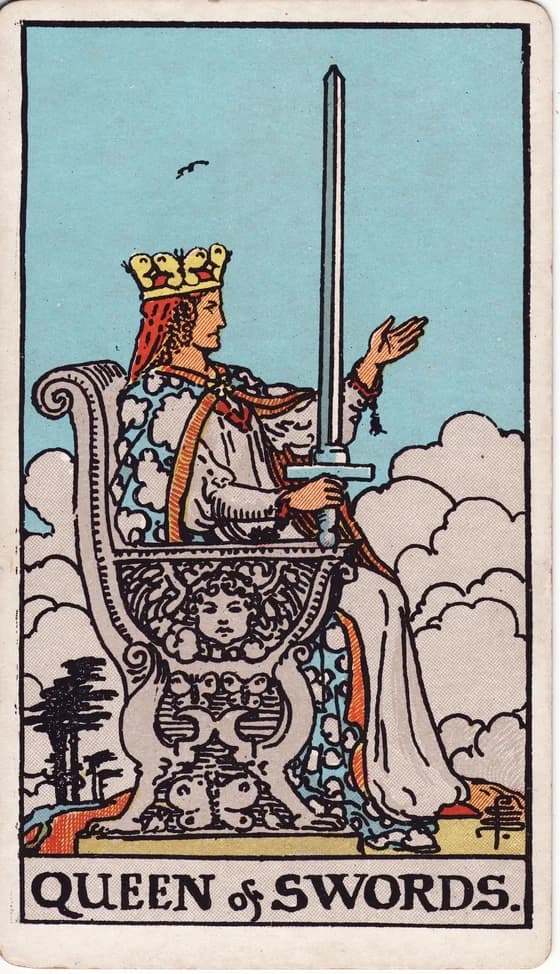
One hand holds the sword and the other reaches out
The Queen sits sideways on a high-backed chair, facing right. The right hand holds a vertical sword while the left extends forward, palm slightly upward. A blue cloak patterned with clouds lies over a white robe. A gold crown rests above red fabric hanging from the head. The stone chair’s side bears a winged face and butterfly-like carvings.
Clouds gather low in the background, with more open sky above and a distant bird. The held sword and extended hand coexist: a clear boundary alongside an outward-facing gesture. This is the article’s interpretive extension, not proof that the figure is refusing something or a rule about who must become “the rational woman.” View the image examined for this article
The modern independent figure is not identical to Waite’s
In the transcription labelled 1911, Waite connects the Queen’s expression with familiarity with sorrow. The old divinatory list leans toward absence, loss and separation. He does not even treat this sword-bearer primarily as a symbol of power, which differs markedly from today’s familiar image of independence and decisiveness.
Drawing on the held sword and extended hand, this article adopts a modern reflective reading of discernment, boundaries and candour. The original’s links between women and marital or reproductive status are not used to judge people, and its reversed disparaging labels are not repeated. The Queen can describe anyone’s approach. Check Waite’s original entry
Upright: State your standards and listen to the facts
Upright, the card can invite you to use experience in evaluating information, express your conditions and accept that some requests cannot be met. Clear standards should be understandable rather than leaving others continually guessing where your limit lies.
Listening does not weaken a boundary. Distinguish the facts, the other person’s needs and what you are willing to undertake before responding. Past experience can sharpen perception, but it needs checking: are this person and situation genuinely the same as the earlier ones?
Reversed: Protect yourself without deciding the case in advance
Reversed, the card can suggest that once-useful protection has become habitual, fitting a new statement into an old conclusion before hearing it fully. Or your language may be so cutting that sarcasm obscures the need beneath it. You can retain the boundary while replacing judgments about someone’s character with specific behaviours and conditions.
A refusal can be complete without being humiliating
If a colleague tries to hand you extra work, state your present capacity and the earliest possible time rather than opening with “Why do you always do this?” They can plan accordingly, and you do not have to keep defending your right to rest.
If a friend repeatedly offers advice, explain that you need listening just now. When editing, distinguish what the writer means from what the words actually convey. A specific comment on a passage supports revision better than “None of this works.”
Practice: Turn criticism into an actionable boundary
Take a harsh sentence you recently wanted to say and remove character judgments such as “You always” or “You are just.” Rewrite it as: “When ___ happens, I will ___; if this is to continue, please first ___.” Check that the condition is specific and reasonable, and leave room for the other person to speak.
The Queen is not a code for marital status
The Queen of Swords cannot establish loneliness, divorce or lack of feeling, and intelligence does not require coldness. Experience and clarity can help a relationship but cannot replace genuine communication and choices on both sides.
Read next
King of Swords: Compare personal boundaries with responsibility for shared decisions; Three of Swords: Acknowledge the hurt in past experience without letting it decide the present.
Sources for this article
- Pamela Colman Smith: Queen of Swords, actual RWS image at the fixed repository commit
- A. E. Waite, The Pictorial Key to the Tarot, Part III, Section 2, Queen of Swords
- Commons Swords13.jpg file page and upload history
Version note: The actual RWS WebP assets from a fixed repository commit were inspected individually. The Commons Pam-A file pages were used to check provenance and versions; no claim of pixel-for-pixel identity between the files is made. Waite is cited from an English transcription labelled 1911. The modern situations, questions and exercises were written originally for DestinyPixel, without borrowing paid card-meaning content.