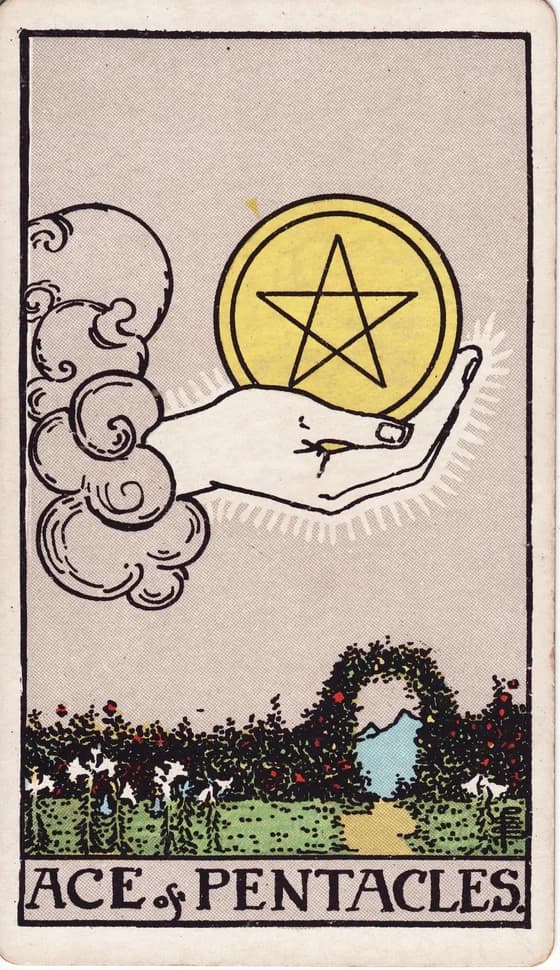
One pentacle and a path into the distance
A grey cloud enters from the left. A white hand supports a yellow disc marked with a pentagram, with short rays around the palm. Below lies a garden: white flowers in the foreground, red flowers dotted through a hedge, and an archway on the right opening onto a small patch of blue in the distance. A yellow path crosses the grass toward the arch; mountains are visible beyond it.
The nearby garden looks tended, while the distant mountains remain unreached. The picture places something accessible beside a route still to be travelled. Reading the disc as money is one possibility. Seeing it as time, a workspace, tools or an opportunity to practise is this article's extension into modern life. View the card image
Waite considers material conditions and what they are good for
In the Ace of Pentacles entry in The Pictorial Key to the Tarot, Waite lists contentment, pleasure, gold and comfortable material conditions. He also mentions great wealth in the reversed entry, while asking whether wealth benefits its owner. The book does not simply equate upright with receiving money and reversed with having none.
Our modern learning theme is “a starting point you can use.” Turning an opportunity into action is the reflective approach developed here, not a project plan already present in Waite's text. Check Waite’s text
Upright Turning favourable conditions into something you can do
The upright card invites a specific check: what is newly available? Someone may be willing to teach you, an afternoon may have opened up, or you may finally have found somewhere suitable to practise. Naming the condition helps you decide how to use it. A vague feeling that things will go well is not enough to support a decision.
You need not use every resource at once. Choose a small, finishable experiment and check the time and continuing upkeep it requires. A useful beginning is not something to preserve ceremoniously; it lets you take a step you could not take before.
Reversed Finding where the opportunity gets stuck
The reversal can prompt a check of your capacity to follow through. You have bought the equipment but have no practice time; someone proposes a collaboration without clarifying who will do what; preparations accumulate while action remains suspended. These situations need specific missing conditions filled in, rather than an even more attractive beginning.
You can also ask whether the apparent benefit carries a cost you do not want to accept. Declining something for now does not mean missing a success that was destined for you. First understand the scope and responsibilities involved.
Giving a beginning a place in your day
At work, when offered a trial assignment, confirm the deliverable and who will give feedback, then make a small version before expanding it. When learning, schedule a short exercise with a new set of tools to see whether you can keep using them.
In a relationship, willingness to share everyday tasks can make commitment observable: arrange a shopping trip or some organising together and see how you divide the work. A gift alone cannot replace communication or prove that a relationship will be stable.
Practice Write a resource-use note
Choose one condition or resource you already have but have not used. Write down one action it could support, when you could finish it and what is still missing. If an essential condition is uncertain, verify it first rather than turning a wish into a promise.
Common misreading
The Ace of Pentacles is not a lottery notification or a guarantee of investment returns or income. Its useful distinction is between having the conditions and having finished the work. The garden gate is open; you still have to arrange your own steps.
Sources and image
The image was drawn by Pamela Colman Smith. The source manuscript was based on inspection of the current original JPEG file; version details come from the Commons file page.
The historical discussion follows this card’s English entry in Part III, Section 2 of A. E. Waite’s The Pictorial Key to the Tarot. The source is the English transcription labelled [1911] by the Internet Sacred Text Archive. A physical 1910 first edition was not checked for this batch. The everyday situations, questions and exercises are original modern reflections, not direct translations of Waite’s book.