The figure moves and the boats rise and fall
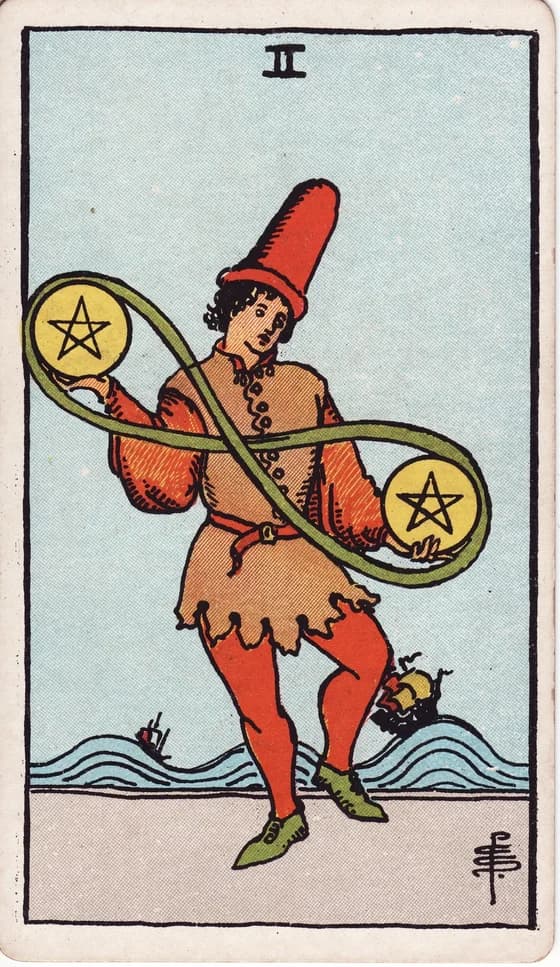
A figure in a tall red hat and orange-red clothes stands in the foreground, leaning to one side and holding a pentacle in each hand. A green ribbon loops around the discs and crosses into a sideways figure eight. The feet are at different heights and the knees slightly bent, suggesting a dance.
Behind the figure, large blue waves carry two small boats at different levels. The ground under the figure is flat and pale; the figure is not standing on a boat. The composition pairs movement nearby with turbulence farther away. It can suggest coordination and adaptation, but does not establish that the person is managing two particular jobs. View the card image
Waite writes of enjoyment as well as trouble
Waite connects the dancing design with gaiety and recreation, while also listing written messages, obstacles and agitation. Reversed meanings include forced enjoyment and matters of writing and documents. This historical list is broader and less consistent than the familiar modern idea of balancing income and spending.
This article develops time and energy coordination from the connected discs and shifting pose. That is a modern reflective reading. Reading the reversal as a performance of ease does, however, connect with Waite's forced gaiety. Check Waite’s text
Upright Adjustment matters more than staying still
The upright card can help when several demands exist at once. Balance need not mean giving everything equal time. It means knowing what matters most today, what can wait and who needs to hear about the change.
A flexible arrangement includes spare capacity. If every minute is allocated, even a small change pushes into everything that follows. Allow time for transitions and delays before deciding how much to accept. Catching everything once does not mean you should have to keep doing it indefinitely.
Reversed You do not have to perform being fine
The reversal can draw attention to difficulties hidden behind a cheerful response: saying “no problem” after accepting two conflicting commitments, or repeatedly filling gaps with last-minute work before taking on something else. The arrangement may be the problem, rather than your competence.
Lay out the tasks and choose which one to cancel, postpone, reduce or share. If you keep refining the timetable without reducing the total load, coordination itself becomes another job.
Seeing how one task affects another
When a project deadline and coursework collide, check which dates genuinely cannot move and negotiate the scope of one task early. Do not wait until the final evening to hope you will suddenly become twice as efficient.
In a shared home, shift work or travel may require a new division of chores this week rather than last month's rota. If you have too many interests, keeping one as your main activity and attending the others occasionally can also support continuity.
Practice Leave a buffer this week
List the three things taking the most energy this week and mark each “fixed” or “adjustable.” Reduce the scope of one adjustable item, then leave a stretch of time unfilled. When the next change arrives, notice whether that space helps.
Common misreading
The Two of Pentacles does not praise unlimited multitasking, nor does it establish that someone has two romantic relationships. Its two discs offer a structural metaphor. What is actually happening still needs to be established through facts and conversation.
Sources and image
The image was drawn by Pamela Colman Smith. The source manuscript was based on inspection of the current original JPEG file; version details come from the Commons file page.
The historical discussion follows this card’s English entry in Part III, Section 2 of A. E. Waite’s The Pictorial Key to the Tarot. The source is the English transcription labelled [1911] by the Internet Sacred Text Archive. A physical 1910 first edition was not checked for this batch. The everyday situations, questions and exercises are original modern reflections, not direct translations of Waite’s book.