Look at the work platform and then the sheet of paper
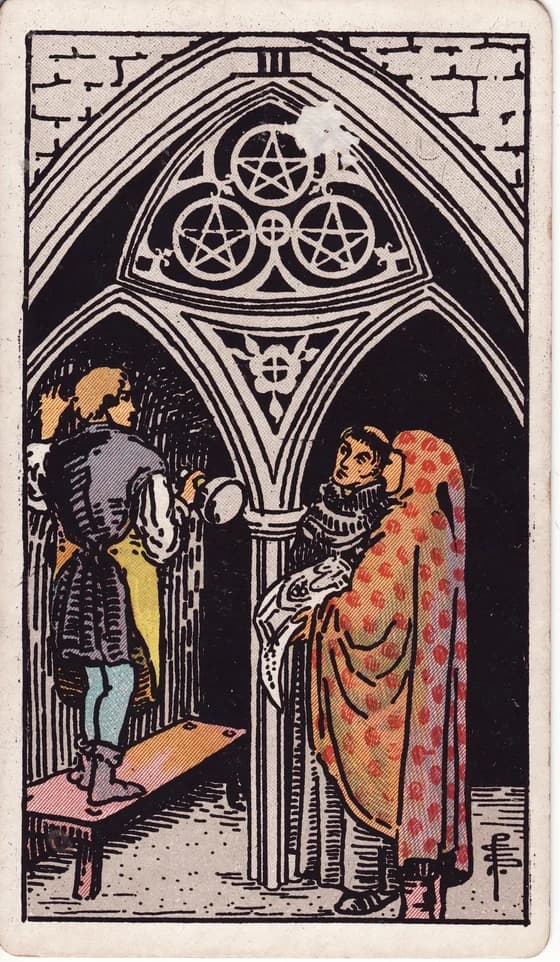
A pointed stone arch occupies the upper picture. Three pentacles are set into its decoration, greyish-white rather than the yellow discs common elsewhere in the suit. On the left, a figure stands on a bench or platform, with tools nearby, and turns toward the two people on the right.
One of those people wears a grey robe. The other wears a garment covered in red circles and holds an open sheet of paper. Lines on the paper suggest a design, but its contents are not labelled. The figures' gazes and positions meet around one working scene. Clothes alone do not establish their job titles or who is paying. View the card image
Skilled work is central to the historical reading
Waite identifies the setting as a monastery and the worker as a sculptor. He asks readers to compare the Eight of Pentacles: the apprentice or amateur has received a reward and is now working in earnest. His main meanings include vocation, trade and skilled labour, alongside older associations with reputation and rank.
The reversed list judges the quality of work negatively. This article does not turn that into a verdict on someone's character. Instead, it develops a modern reading about shared standards and collaborative processes. “Three people must make a perfect team” is not Waite's conclusion. Check Waite’s text
Upright Give skill a useful place
The upright card asks what you can contribute and how that contribution connects to a shared goal. Skilled workers need to explain limits; organisers need to understand practical work; those requesting it need to turn expectations into standards that can be checked.
Recognition is more than praise. Enough time, necessary information and room for professional judgment to affect the plan allow ability to be used. Contributions and responsibilities should also be clear, so that someone is not repeatedly overlooked after the work is finished.
Reversed Check the joins first
When the result refuses to take shape, check whether people mean different things by “finished.” One person thinks the design is final while another is still gathering ideas. Someone is working to old dimensions after the venue has changed. Repairing these joins is often more useful than urging everyone to try harder.
If the skill itself is still developing, identify the part that needs guidance. Admitting you cannot yet do something does not erase your value. Hiding the difficulty until the end makes useful cooperation harder.
Make collaboration something you can check
Before a work review, bring a sample and two or three clear questions. That is more likely to produce useful feedback than “What do you think?” When co-writing a course report, agree on sources and structure before writing separate sections.
When arranging a home together, one person may be good at measurements while another understands how the space will be used. Let both kinds of information shape the decision. The loudest voice does not necessarily know every detail best.
Practice Map one handover
Choose a task involving at least two people. Write down what each person provides, who receives it and how the recipient will know it is usable. Find the least clear part, arrange a brief check and leave a record both people can consult.
Common misreading
The Three of Pentacles cannot guarantee promotion, and gathering three people does not ensure successful teamwork. Its useful lesson is to connect skills, needs and feedback, rather than merely looking like a team.
Sources and image
The image was drawn by Pamela Colman Smith. The source manuscript was based on inspection of the current original JPEG file; version details come from the Commons file page.
The historical discussion follows this card’s English entry in Part III, Section 2 of A. E. Waite’s The Pictorial Key to the Tarot. The source is the English transcription labelled [1911] by the Internet Sacred Text Archive. A physical 1910 first edition was not checked for this batch. The everyday situations, questions and exercises are original modern reflections, not direct translations of Waite’s book.