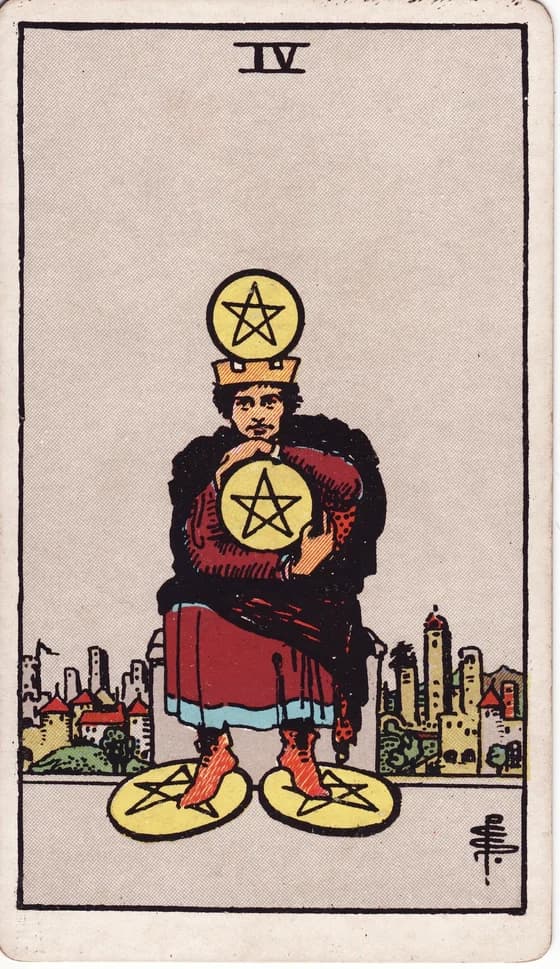
The body becomes a frame for keeping the pentacles
A crowned figure sits facing forward on a stone seat, wearing a red robe and dark outer garment. Both arms circle a large pentacle at the chest; another stands above the crown, and each foot rests on one. The discs occupy the head, hands and feet in a tightly arranged vertical composition.
A city spreads behind the figure, with towers, walls and red roofs. The figure sits apart on open ground in front of it, with no one else interacting. What we can see is stillness and a firm hold. Fear of loss is an interpretation prompted by that posture, not direct knowledge of the person's thoughts. View the card image
Holding on has a direct basis in the text
Waite briefly describes the figure as holding to what is already possessed. His upright meanings concern secure possessions, attachment to what one has, gifts and inheritance. Reversed, he gives suspense, delay and opposition, rather than directly stating the familiar modern idea of “letting go.”
This article extends preservation to time, access, belongings and personal limits. The reversal checks boundaries that are too tight or too loose. This is a contemporary reflective method, not a rewritten list presented as Waite's original. Check Waite’s text
Upright Keep what genuinely matters
The upright card need not immediately mean stinginess. During change, keeping a familiar space, reducing extra commitments or giving important belongings a fixed place may provide real stability. Ask what you are protecting before deciding whether the boundary fits.
A useful boundary can be explained and adjusted. You might reserve part of each day for taking no new tasks while agreeing how urgent matters should reach you. It protects your capacity to keep living; it need not seal off every contact.
Reversed Notice the cost of control
If fear of mistakes means everything must go through you, safekeeping can become a bottleneck. You retain decision-making power but lose rest and room to collaborate. Distinguish responsibilities you truly cannot pass on from work someone else could handle under clear rules.
Alternatively, fear of seeming ungenerous may lead you to accept requests beyond your capacity. Letting go also needs limits: when will a borrowed item return, or how far may someone use shared material? Clear terms are steadier than swinging between total restriction and total openness.
Allowing protection and movement together
A team lead can start by handing over one low-risk task with agreed check-in points. When sorting possessions, distinguish useful items, keepsakes and things kept “just in case,” then decide item by item.
In a relationship, a need for solitude can be stated with a time and reason. Silence or repeated testing to make sure someone will not leave may create a sense of control without genuine reassurance.
Practice Give a boundary a reason
Complete these sentences: “I want to keep … because it helps me …” and “I can make … available, provided that …” If the reason is simply “I must control everything,” look again for a more specific need that can be discussed.
Common misreading
The Four of Pentacles neither labels someone a miser nor asks you to immediately discard or surrender everything. The question is whether a boundary serves an actual need and whether its cost remains manageable.
Sources and image
The image was drawn by Pamela Colman Smith. The source manuscript was based on inspection of the current original JPEG file; version details come from the Commons file page.
The historical discussion follows this card’s English entry in Part III, Section 2 of A. E. Waite’s The Pictorial Key to the Tarot. The source is the English transcription labelled [1911] by the Internet Sacred Text Archive. A physical 1910 first edition was not checked for this batch. The everyday situations, questions and exercises are original modern reflections, not direct translations of Waite’s book.