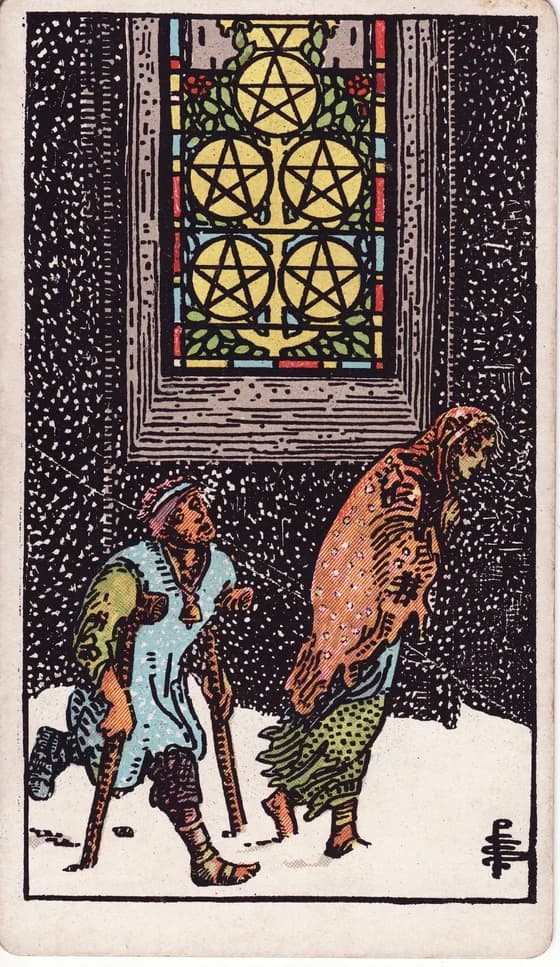
The people in the snow are not standing at a doorway
White snow dots cover a black background as two people move to the right. The leading person wraps an orange-brown cloth around the head and body, with ragged clothing visible below. The person behind wears blue, uses crutches and has one foot raised; lines around the leg suggest wrapping.
Above them is a narrow stained-glass window containing five yellow pentacles among red, blue and green decoration. The frame is thick and the ground snowy. No door or people inside are shown. The image alone cannot establish that turning back would certainly let them enter. View the card image
Waite describes material trouble and acknowledges conflicting readings
Waite primarily associates this card with material difficulty. He also records other readers' meanings involving relationships and affinity, explicitly saying that these interpretations cannot be reconciled. His reversed meanings remain concerned with disorder and discord; they cannot simply be translated as “the difficulty is about to end.”
This article focuses on practical needs, exclusion and the conditions for obtaining help. Using the reversal to ask about reconnecting with support is a modern reflective reading. It neither treats hardship as a moral defect nor turns the depicted physical condition into a health prediction. Check Waite’s text
Upright Separate need from shame
The upright card can help you acknowledge that something really does exceed the resources currently available. A shortage of time, support or essentials does not disappear through optimism. Identify the most urgent need and the problems that can wait before deciding what comes next.
A specific request makes it easier to work out who can respond. “Could you cover one shift for me this week?” is more actionable than “I cannot do anything right.” The other person may not be able to agree. One refusal does not establish that you are undeserving of help.
Reversed Check improvement against facts
Ask whether you now know where to enquire, whether someone can accompany you, or whether a practical barrier has been removed. Recording these small changes is more reliable than announcing a turn of fortune. If resources remain inaccessible, keep checking barriers involving eligibility, cost, transport or information.
Another reading concerns hidden difficulty: accepting arrangements you cannot manage in order not to appear behind everyone else. Saying “I cannot manage this arrangement at present” can make room for understanding and adjustment.
Support needs to reach the person who needs it
At work, if you have been left out of necessary discussions, identify the missing information and ask the responsible person for specific access or updates. Do not immediately interpret an information gap as proof that everyone rejects you.
If friends' gathering plans exceed what you can manage, suggest a more workable activity. If basic living needs are affected, prioritise real public services or trustworthy people you can contact. A card cannot supply essential resources itself.
Practice Write a request you could actually send
Choose one immediate need. State what is missing, what help you are asking for and how long you need it. Then check one person or service that may be able to respond. You do not have to recount your entire history before you are entitled to ask whether help is available.
Common misreading
The Five of Pentacles does not predict illness, disability or inevitable job loss, nor does it prove that poverty results from insufficient effort. The window's light may encourage a search for access, but it should not make us overlook real barriers or blame people who have not received help.
Sources and image
The image was drawn by Pamela Colman Smith. The source manuscript was based on inspection of the standard 500px thumbnail listed on the file page; version details come from the Commons file page.
The historical discussion follows this card’s English entry in Part III, Section 2 of A. E. Waite’s The Pictorial Key to the Tarot. The source is the English transcription labelled [1911] by the Internet Sacred Text Archive. A physical 1910 first edition was not checked for this batch. The everyday situations, questions and exercises are original modern reflections, not direct translations of Waite’s book.