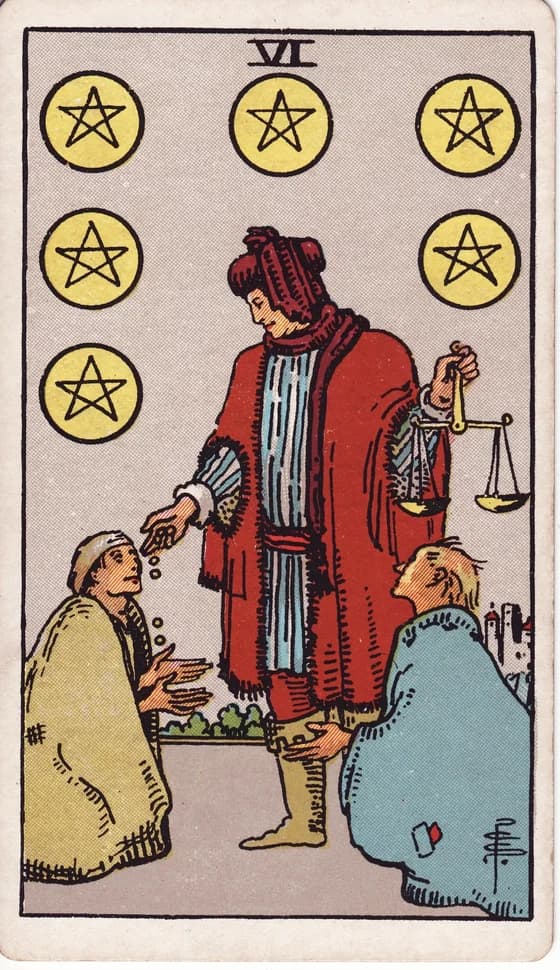
The standing figure holds both scales and coins
The central figure wears a red cap and outer garment over a blue-and-white striped robe. One hand holds a small balance; the other drops coins toward the person below on the left. Two people in patched garments kneel and reach toward the central figure. The covering on the left is yellowish, the one on the right blue.
Six large pentacles float above: three on the left, one in the middle and two on the right. Their pictorial placement differs from that of the small falling coins. Trees and buildings appear in the distance. The scales introduce the act of weighing, but do not by themselves prove fairness; the picture does not say how much the person on the right will receive next. View the card image
Waite emphasises gifts and goodwill
Waite describes the central figure as a merchant and reads the distribution as evidence of success and a good heart. His meanings include presents, gifts, gratification and present prosperity. Reversed, he lists desire, greed, envy and illusion.
This article retains giving and receiving while adding modern questions about rules, respect and differences in power. These extend reflection on the pictured relationship. They should not be presented as evidence that Waite himself criticised the giver's motives. Check Waite’s text
Upright Make help genuinely usable
There are two positions from which to approach this card. If you have capacity to help, first ask what is actually needed, then say how much you can provide and for how long. If you need help, you can accept support with clear limits without immediately trying to repay everything to remove your discomfort.
Useful help leaves room for the recipient's views. One act of support should not automatically buy lasting authority, and gifts should be distinguished from loans in advance. Discussing terms need not diminish goodwill; it can prevent later misunderstanding.
Reversed Check the unspoken exchange
Imbalance sometimes hides inside “I only want what is best for you”: a little help becomes a demand for constant obedience, or someone keeps giving beyond their capacity in order to feel needed. Examine the actual arrangement before deciding how to change it.
You may also habitually refuse all help because accepting seems to create an unpayable debt. Check the person's actual expectations. Distinguish support whose terms can be discussed from help that genuinely carries controlling conditions.
Look at distribution in everyday relationships
When allocating equipment or training places at work, explain the criteria and application process so resources do not only reach the most vocal people. If a friend helps edit a piece of work, agree beforehand which part to review and how much time to spend.
In a shared home, when someone temporarily takes on more tasks, agree when to review the arrangement rather than letting temporary help quietly become a permanent obligation. The person receiving support should also take part in the discussion.
Practice Clarify one offer of help
Choose support you are currently giving or receiving. Write down its content, duration, decision-making rights and expectations of return. If either person understands one of these differently, clarify it in a specific conversation instead of guessing at the debt involved.
Common misreading
The Six of Pentacles does not guarantee a cash gift, nor can it establish that a helper is insincere. It invites you to check whether support is useful, its terms transparent and the recipient's dignity and choices preserved.
Sources and image
The image was drawn by Pamela Colman Smith. The source manuscript was based on inspection of the current original JPEG file; version details come from the Commons file page.
The historical discussion follows this card’s English entry in Part III, Section 2 of A. E. Waite’s The Pictorial Key to the Tarot. The source is the English transcription labelled [1911] by the Internet Sacred Text Archive. A physical 1910 first edition was not checked for this batch. The everyday situations, questions and exercises are original modern reflections, not direct translations of Waite’s book.