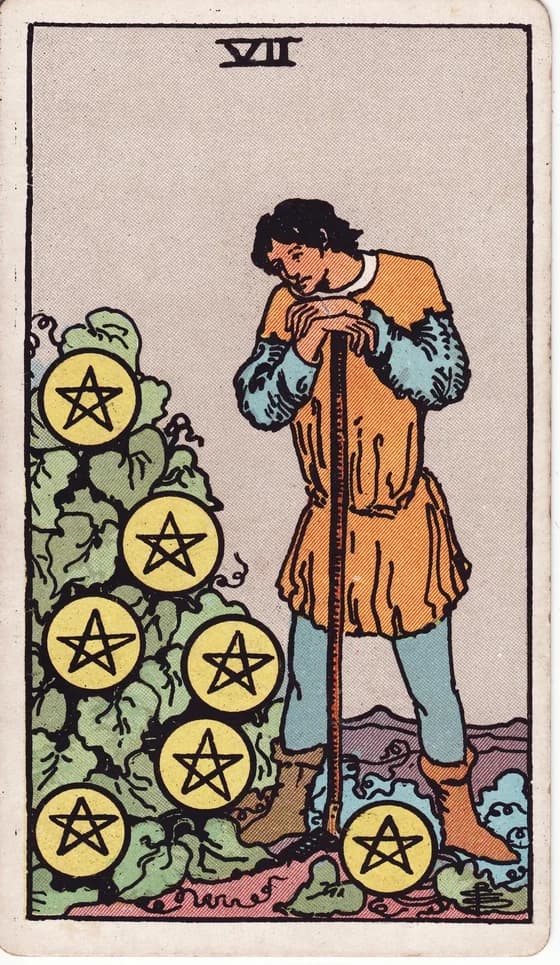
Six pentacles among the leaves and one near the feet
On the right, a figure wears an ochre tunic, blue sleeves and trousers. Both hands rest one over the other on a long handle, with the head tilted down to the left. Six yellow pentacles sit among the green leaves on the left; a seventh lies lower, near the person's feet and the base of the plants.
Brown lines suggest disturbed soil, low hills sit in the distance and a large area of pale sky remains open. The handle resembles a gardening tool, but the image does not clearly show it being used. The person is neither picking the discs nor stepping forward. The idea of assessing a harvest develops from this pause. View the card image
Patient waiting is not the only historical meaning
Waite describes the figure studying the pentacles among the greenery as though they were treasured possessions. He then acknowledges highly contradictory meanings, principally money and exchange but also disputes and other readings. His reversed entry specifically concerns anxiety over money proposed as a loan.
This article organises its modern interpretation around effort and feedback. It does not reduce Waite's varied meanings to “wait and a reward is certain.” Real results need to be judged from real evidence. Check Waite’s text
Upright Let observation shape the next step
The upright card suits a midway check. After spending time, you need to know what has changed and what has not. Look beyond final results: is the process more stable, has a difficulty eased, and do your initial assumptions still hold?
Some things need longer; some methods need changing. To distinguish them, decide what signs you expect and when you will check again. Waiting without a standard can easily blur patience into postponement.
Reversed Do not let the past decide the future
The reversal can examine two opposing pulls. One is changing methods every few days before there is time to observe their effect. The other is seeing a problem but refusing to stop because so much has already been done. Past effort deserves recognition, but does not automatically make continuation the best choice.
Write down feelings separately from the assessment. You can be disappointed while reconsidering the resources still available. Changing your approach need not deny past effort; those attempts have still given you information.
Pause before continuing
When learning a language, compare exercises of similar difficulty across several attempts to identify improvement and recurring errors, rather than counting hours alone. When running a content series, check audience feedback and your capacity to keep producing before changing the frequency.
In a relationship's long-term plans, observe whether both people have followed through on smaller commitments. The length of one person's wait does not replace checking for shared willingness.
Practice Set a review point
Write down a current plan, the changes you can presently observe and the next review date. Decide in advance what would justify continuing, adjusting or pausing. Let the decision rest on more than that day's mood.
Common misreading
The Seven of Pentacles promises no reward proportional to effort and offers no investment timing. Its pause can support careful assessment, but cannot establish that a particular commitment deserves more time. Patience needs to work alongside facts.
Sources and image
The image was drawn by Pamela Colman Smith. The source manuscript was based on inspection of the standard 500px thumbnail listed on the file page; version details come from the Commons file page.
The historical discussion follows this card’s English entry in Part III, Section 2 of A. E. Waite’s The Pictorial Key to the Tarot. The source is the English transcription labelled [1911] by the Internet Sacred Text Archive. A physical 1910 first edition was not checked for this batch. The everyday situations, questions and exercises are original modern reflections, not direct translations of Waite’s book.