Finished work forms a row while the hands keep working
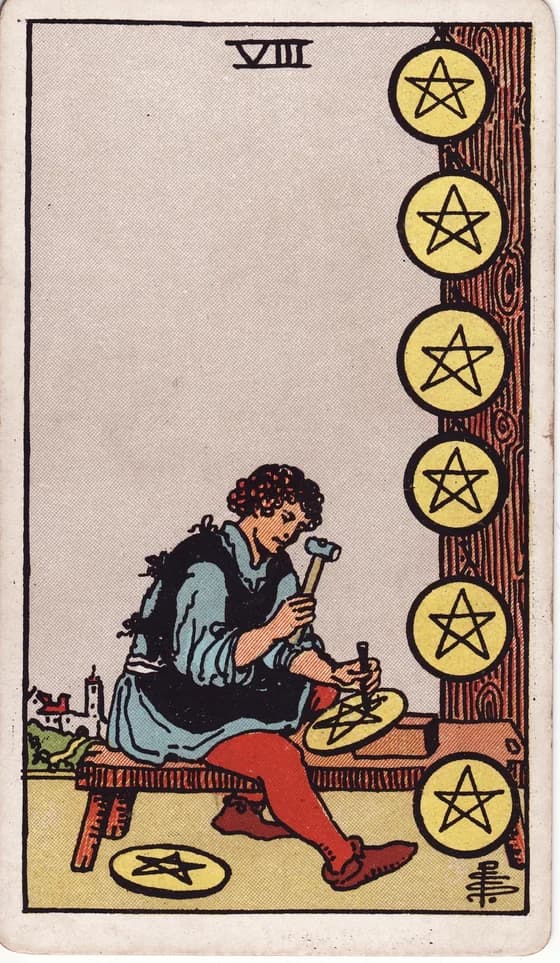
A figure sits on a wooden bench in a blue shirt, a black outer garment and red trousers. One hand raises a small hammer; the other positions a tool near a yellow disc. The body bends toward the work. Six pentacles line the upright board on the right, one lies on the ground and one is being worked on, making eight in all.
Distant houses and trees appear on the left; no other person is nearby. The composition directs attention to the hands and distinguishes completed work from work in progress. The discs carry similar patterns, but the image gives no quality scores and does not require the worker never to stop. View the card image
Waite writes about work and craftsmanship
Waite identifies the figure as an artist working in stone. His meanings include work, employment, commissions, craftsmanship and skill, possibly in a preparatory stage. Comparing this card with the Three of Pentacles offers a useful thread between learning and professional application.
Reversed meanings include vanity, excessive demands and using skill for harmful purposes. This article therefore considers what skill serves, while adding modern methods of feedback, pacing and improvement. Reading the reversal as “no talent” is neither necessary nor justified. Check Waite’s text
Upright Narrow the action and sharpen the feedback
The upright card encourages breaking a large goal into a repeatable unit. Instead of “improve my writing,” practise making one paragraph's central point clear. Instead of “learn photography,” compare compositions in the same setting. A precise scope makes actual change easier to identify.
Keep a sample after each exercise. Correct the most consequential issue before increasing the difficulty. Consistency does not require equal intensity every day; rest and reviewing experience can make the next round more accurate.
Reversed Ask whether repetition is still useful
If you only complete a quota, familiarity may conceal the same repeated mistake. Try a different source of feedback or slow the process down so overlooked details become visible. Growing harsher toward yourself does not necessarily improve the work.
Skill may also become detached from purpose: making something simple difficult in order to appear impressive, or endlessly polishing an unimportant detail and never delivering. Return to the user and the actual requirements to decide where the effort belongs.
Practice can happen at different scales
At work, create a template for a frequently used document, ask its actual users to try it and revise the fields they misunderstand. When practising an instrument, slow down one difficult passage and compare recordings rather than forcing your way from beginning to end each time.
Cooking can also provide practice: hold the ingredients and steps steady for one attempt and note which step affects the texture. An interest need not become a competition for you to enjoy becoming more skilled.
Practice Keep a before and an after
Choose an action that can be repeated within twenty minutes and keep the first result. Change only one thing, try again and record the difference. If no change is visible, ask a specific question or choose a clearer way to compare.
Common misreading
The Eight of Pentacles does not make longer overtime more admirable or guarantee that diligence will secure a position. Its lesson is to give effort useful feedback and skill a real purpose, rather than turn yourself into a machine that cannot stop.
Sources and image
The image was drawn by Pamela Colman Smith. The source manuscript was based on inspection of the current original JPEG file; version details come from the Commons file page.
The historical discussion follows this card’s English entry in Part III, Section 2 of A. E. Waite’s The Pictorial Key to the Tarot. The source is the English transcription labelled [1911] by the Internet Sacred Text Archive. A physical 1910 first edition was not checked for this batch. The everyday situations, questions and exercises are original modern reflections, not direct translations of Waite’s book.