The cup she studies has a lid
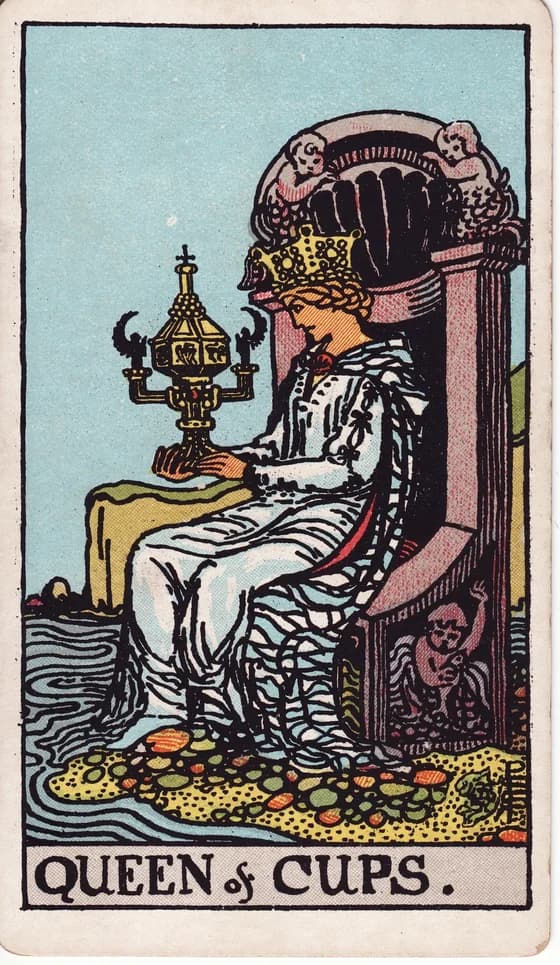
A crowned figure sits in profile on a stone throne beside water, wearing a pale dress and a cloak patterned with dark waves. Both hands support an elaborate golden vessel. The cup has a high lid, a narrow finial and wing-shaped ornaments projecting from either side, unlike the open cups found on most other Cups cards.
The high back of the throne curves like a shell, with childlike or aquatic human forms carved along its edges and another decorative relief at the side. Colourful rounded stones lie on the narrow shore at the figure’s feet, with blue water close to the throne. The gaze rests on the cup; the figure neither waves it outward nor pours its contents for anyone else. View the card image
Waite explicitly says she also acts
The 1911 English transcription of Waite’s The Pictorial Key to the Tarot describes a dreamy gaze but immediately adds that she acts as well as sees, and that action nourishes her vision. It speaks of loving intelligence alongside period ideals of wifehood and motherhood. This site retains care and action without restricting the card to women or family carers. Waite’s entry for this card
The reversed entry acknowledges conflicting accounts while including harsh judgements of women’s character. This article does not adopt those labels. Over-involvement and neglect of one’s own needs are modern reflective directions used below.
Upright: Understand first, then choose how to help
Upright, the card can remind you to make room for feelings. When someone describes a difficulty, first check whether you have understood, then ask whether they want listening, advice or practical help. Attentive care does not require correctly guessing every private thought.
Give yourself the same attention. Recognising tiredness, hurt or unwillingness does not lessen care; it helps determine how much you can offer now. Care with a defined scope is more stable than silent overextension followed by sudden exhaustion.
Reversed: Separate empathy from living someone’s life for them
The reversal can help you examine whether every change in another person’s mood feels like a problem you must solve, or whether their unhappiness immediately feels like your fault. You can understand someone while leaving them responsible for their choices and behaviour.
Another possibility is trusting intuition so completely that you overlook what the person explicitly asks for. Replace “I think you need this” with “I noticed this; how would you like to handle it?” If caring leaves you unable to rest, reducing your role and finding additional support together can be responsible choices.
Let gentleness answer a real need
When a friend talks about a setback at work, first ask whether they simply want to talk for a while. Offering company does not mean messaging colleagues for them or deciding they should resign.
If a teammate seems tired, ask privately about their workload and discuss possible adjustments. Do not infer their private circumstances from your own impressions. When a feeling inspires creative work, put it into a draft first and decide what to share publicly after the feeling has settled.
Practice: Define the scope of your care
Choose something you are currently helping with. Write down the need the other person explicitly expressed, what you can realistically offer, and what they must decide themselves. If the first category is empty, ask first. Make help a specific action with a beginning and end rather than permanent availability.
A common misreading
The Queen of Cups does not certify mind-reading, foresight or perfect motherhood, and a reversal cannot establish that someone’s emotions are abnormal. Sensitivity is a way of observing; judgement still needs facts and questions. People of any age or gender can practise this card’s listening, attunement and boundaries.
Read alongside
Page of Cups: Move from recognising feelings towards mature care; King of Cups: Compare close understanding with steadiness while carrying responsibility.
Sources for this article
- Pamela Colman Smith: Queen of Cups, Commons Pam-A scan
- A. E. Waite, The Pictorial Key to the Tarot, Part III §2, Queen of Cups
Edition note: the text was checked against the English transcription at Sacred Texts labelled [1911]. The image is the scan currently labelled Pam-A on Commons. The modern situations, questions and exercises were written originally by DestinyPixel. Historical divinatory terms are learning material, not predictions or evidence about real events.