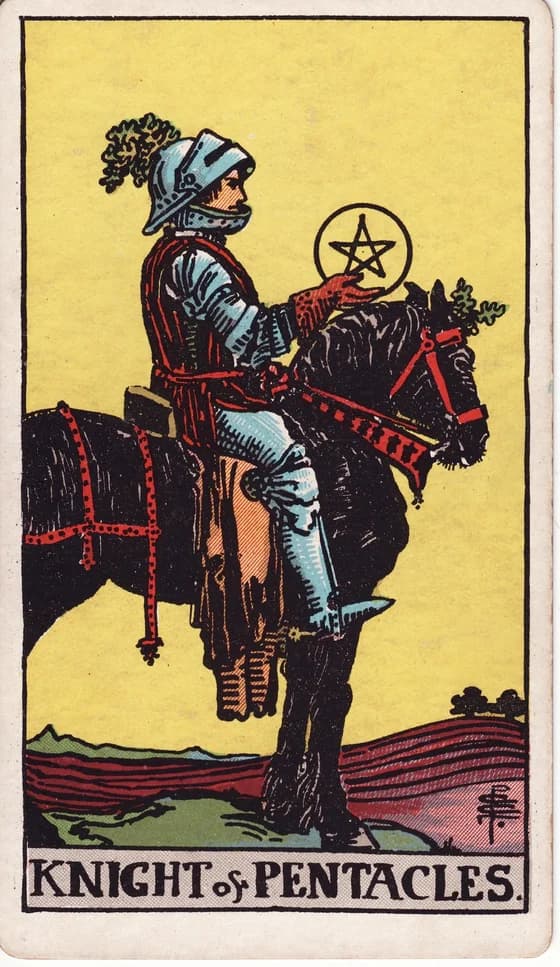
A heavy horse faces the fields and a pentacle is held ahead
The rider wears blue-grey armour, with green leaves on the helmet and red fabric falling behind the shoulders. A gloved hand holds the pentacle forward while the rider sits upright. The dark horse has a heavy build, red tack and leafy head decoration. Its visible front legs are straight, without a clear forward stride.
Red-brown furrows run across the background, with low hills and a tree beneath a broad yellow sky. There is no charge, opponent or rising dust. Connecting the field with regular labour is natural, but the picture does not establish who owns it or what the rider will do next. View the card image
Responsibility is closer than speed to Waite's emphasis
Waite describes a slow, enduring, heavy horse whose character matches the rider's. Upright meanings include usefulness, service, responsibility and integrity; reversed meanings include stagnation, idleness, discouragement and carelessness. These provide a clear historical basis for dependable action.
This article develops them into sustainable steps and the management of commitments. The court role describes a way of acting that people of any age or gender may use; it need not be fixed to a particular type of partner. Check Waite’s text
Upright Make clear what others can depend on
Reliability does not mean agreeing to everything. It means knowing your responsibilities and meeting them as agreed. If circumstances change, early notice and revised arrangements are also responsible actions. Quiet effort has value without repeated declarations of enthusiasm.
Give recurring tasks a workable rhythm: when to begin, what counts as complete and where to record exceptions. A process should reduce forgetting and repeated decisions, leaving attention for problems that genuinely need it.
Reversed Distinguish steadiness from resistance to change
The reversal can test whether a familiar method still fits. Ignoring new requirements because this is how things have always been done can turn stability into rigidity. Alternatively, ever more detailed preparation without action may be cushioning fear of mistakes.
Choose the smallest actual step and give it a check-in point. If continued effort is exhausting, adjust the workload and pace. Responsibility does not require unlimited endurance, and rest should not casually be called laziness.
Reliability can be tested in small things
For a recurring report, use a fixed information-checking list and explain exceptions promptly. For a skill that takes time, choose a sustainable practice frequency rather than a frantic first week followed by complete inactivity; that also makes change easier to observe.
In a relationship, contact someone when you said you would, or give advance notice when you cannot. Simple follow-through can provide reassurance, but it still needs conversation and responsiveness; it cannot replace every form of emotional expression.
Practice Design a minimum sustainable version
For a long-term task, write down the smallest version you can manage during a busy period and when you will return to the usual level. After using it for a while, review which steps help and which are merely ritual. Keep the purpose and allow the form to change.
Common misreading
The Knight of Pentacles does not mean dullness or guarantee someone's absolute loyalty. Slowness can come from care or from stagnation. Look at actual action and feedback rather than defining a person by the speed shown on a card.
Sources and image
The image was drawn by Pamela Colman Smith. The source manuscript was based on inspection of the current original JPEG file; version details come from the Commons file page.
The historical discussion follows this card’s English entry in Part III, Section 2 of A. E. Waite’s The Pictorial Key to the Tarot. The source is the English transcription labelled [1911] by the Internet Sacred Text Archive. A physical 1910 first edition was not checked for this batch. The everyday situations, questions and exercises are original modern reflections, not direct translations of Waite’s book.