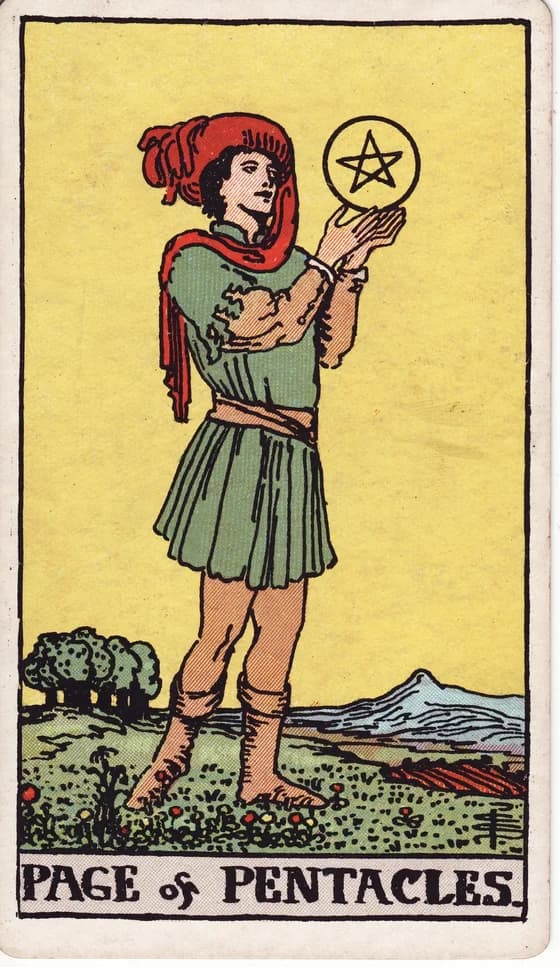
The pentacle is raised while the feet stay on the ground
A youthful-looking figure wears a green tunic, ochre trousers and brown boots, with a red headpiece and long trailing fabric. Both hands lift above chest height, the fingers close to the yellow pentacle's lower edge, and the face turns toward it. Little else interrupts the wide yellow sky.
Flowers dot the grass underfoot. Trees stand at the back left; a dark, striped field and blue mountains appear to the right. The body leans slightly forward, but a static pose cannot establish its speed. The attention shown in the picture is not yet proof of understanding the object. View the card image
Study and reflection are direct historical meanings
Waite describes a figure concentrating on the pentacle above raised hands, moving slowly and scarcely noticing the surroundings. His upright list includes application, study, scholarship and reflection, alongside messages and management. Reversed, he mentions dissipation, luxury and unfavourable news, among other older meanings.
This article follows the learning theme from curiosity into practice. The Page represents an approach you can adopt, not a restriction of age, gender or status. Returning to study in adulthood can begin here too. Check Waite’s text
Upright Allow yourself basic questions
The upright card can make the wish to understand more concrete. In a new field, choose a small object, a basic operation or an answerable question. Find a trustworthy source, then explain the idea in your own words to discover what remains unclear.
Awkward beginnings do not prevent serious effort. Check whether your entry point suits your present level and whether you can obtain corrections. Showing an unfinished attempt is often more useful than pretending to understand already.
Reversed Check where attention is going
The reversal can examine the difference between collecting and learning. Courses, notes and tools multiply without a single practical application, or you only explore the entertaining parts while avoiding the basics that repeatedly stop you. Reduce the incoming material and make room to complete one exercise.
When receiving news, distinguish rumour from confirmed information. If a learning or work opportunity sounds attractive, check its source, requirements and deadline. Matching your hopes is no reason to skip necessary enquiries.
Make curiosity small enough to act on
When learning new software, first complete one simple task from input to export, recording where you get stuck. When studying a plant, observe the light and soil over a week before consulting relevant material.
For new work responsibilities, ask someone experienced to demonstrate a real process and then repeat it yourself. Pointing to the exact step you do not understand invites better guidance than repeatedly saying you are not good at it.
Practice Keep one page of learning notes
Use three parts only: today's question, what you tried and one point still unclear. The next day, address that unclear point before adding more material. Let the record serve understanding rather than become a beautiful collection.
Common misreading
The Page of Pentacles promises no admission, qualification or favourable message, and does not identify a particular young person. It offers an entry into learning and verification. Ability still develops through actual practice.
Sources and image
The image was drawn by Pamela Colman Smith. The source manuscript was based on inspection of the current original JPEG file; version details come from the Commons file page.
The historical discussion follows this card’s English entry in Part III, Section 2 of A. E. Waite’s The Pictorial Key to the Tarot. The source is the English transcription labelled [1911] by the Internet Sacred Text Archive. A physical 1910 first edition was not checked for this batch. The everyday situations, questions and exercises are original modern reflections, not direct translations of Waite’s book.