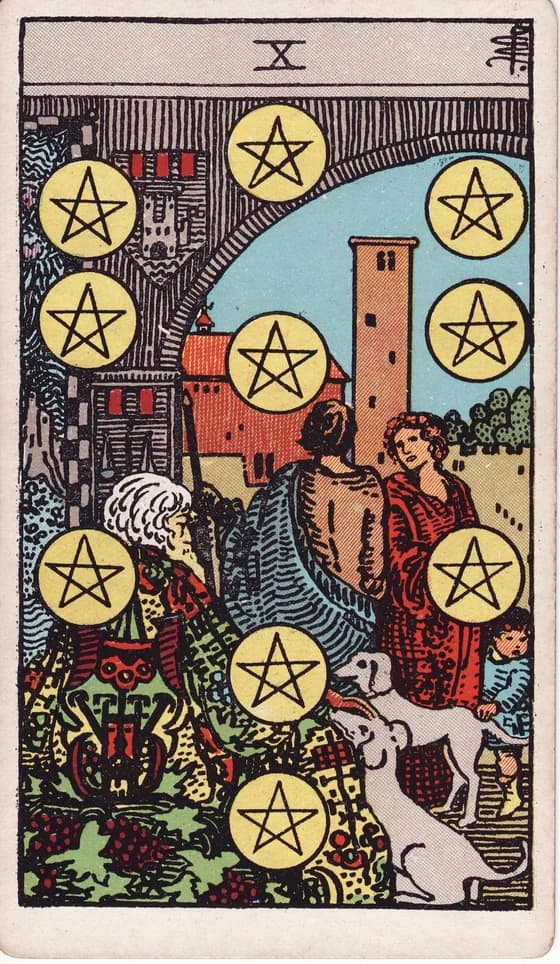
An arch connects generations and a home
An older white-haired person sits in the left foreground, wearing a robe crowded with richly coloured designs. Two pale dogs are near the person's hand and knees. A child on the right is only partly visible, with one hand on a dog. Two adults stand together in the middle distance, one turned away from us and one toward the companion.
They stand beneath a large arch. Houses and a square tower are visible beyond, with a shield-shaped emblem on the building at the left. Ten pentacles overlay the whole picture: some cover architecture and others clothing. They are not stacked in a single chest. The image also does not establish every relationship among the people present. View the card image
Family matters and archives appear in Waite's list
Waite describes an archway leading to a house and domain, noting the two adults, child, dogs and older figure in front. Alongside wealth, his upright meanings include family matters, archives, ancestry and the family home, already extending the subject across generations.
His reversed list is mixed, including chance and loss as well as gifts and a pension. This article does not use it to predict family events. It develops a modern question about whether shared arrangements can last. Here, community can include chosen family and collaborative groups. Check Waite’s text
Upright Make stability something others can use
The upright card can focus on what has accumulated: shared experience, reliable relationships, reusable methods or a place where people can return and rest. One value of accumulation is that others need not begin from nothing every time.
Leaving experience available takes more than “I will explain later.” Where are the materials, who knows how to use them, who handles maintenance, and how will changes be discussed? Such arrangements turn continuity into an actual capacity rather than an attractive vision.
Reversed Hear different needs within the group
The reversal can ask whether “we have always done it this way” has become a refusal to talk. Established habits may help some people while leaving others with long-standing invisible work. Put responsibility and participation on the table to see what needs adjusting.
Also notice whether one person alone holds essential knowledge: where information is stored, who to contact or how a process works. If that person cannot continue, everyone may struggle. Prepare a handover before a crisis forces it.
Put continuity into practical arrangements
When a team project closes, organise instructions, common questions and unfinished tasks so the next person has a way in. People sharing a home can periodically discuss cleaning, repairs and visitors instead of relying on someone to quietly fill every gap.
At a family gathering, ask older relatives which stories they would like to preserve and listen to how younger members want to take part. Keeping shared memories does not require everyone to follow the same path in life.
Practice Make a small handover
Choose an everyday task that only you know well. Write the minimum information someone else would need and ask that person to try it. Add answers to the questions the trial reveals. Being usable matters more than appearing comprehensive.
Common misreading
The Ten of Pentacles guarantees neither an inheritance, a happy marriage nor a prosperous family background. It does not require sacrificing personal wishes to family expectations. It is better used to ask who benefits from an arrangement, who maintains it and how it can continue.
Sources and image
The image was drawn by Pamela Colman Smith. The source manuscript was based on inspection of the standard 500px thumbnail listed on the file page; version details come from the Commons file page.
The historical discussion follows this card’s English entry in Part III, Section 2 of A. E. Waite’s The Pictorial Key to the Tarot. The source is the English transcription labelled [1911] by the Internet Sacred Text Archive. A physical 1910 first edition was not checked for this batch. The everyday situations, questions and exercises are original modern reflections, not direct translations of Waite’s book.